This page was originally written in Japanese and has been translated into English. Some photographs retain Japanese annotations; the text and captions explain the construction in English.
Layout
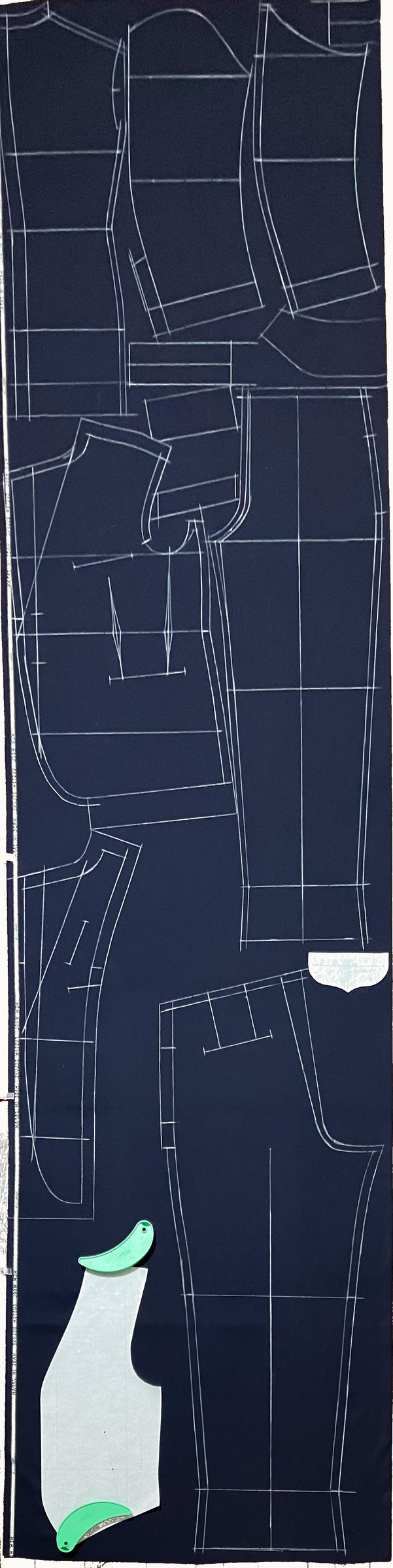
Placing the pattern on the cloth. Match the grain and the nap, allow for the seams, and use the cloth without waste. With a guide to how much double-width cloth a garment takes.
Placing the pattern on the cloth is called the layout. The less cloth is left over, the shorter the length needed and the lower the cost of the material.
But a layout is not simply a matter of fitting the pattern on. Two directions constrain it, the grain and the nap, and the seam allowance and inlay have to be allowed for as well. Get these wrong and there is no going back once the cloth is cut.
Before laying out
The cloth is put in order first. For wool the work goes shrinking → layout → cutting → tailor’s tacks.
Shrinking shrinks the cloth as far as it will go and sets the warp and the weft square to one another. Without it the cloth shrinks or goes out of true during the making, and trouble follows.
Cotton and linen need washing before the shrinking.
Both belong before the layout. Neither can be put right once the cloth is cut.
Matching the grain
Every piece has its grain, the direction of the warp. The grain marked on the pattern has to run with the warp of the cloth.
Cloth with a nap
On a cloth with a nap, such as melton or flannel, the length of the cloth has a direction: with the nap and against the nap. Brushing from top to bottom without raising the pile is with the nap.
On an overcoat the pieces are normally laid with the nap running that way, and on a cloth with a nap every piece must run the same way. If one piece runs the other way it catches the light differently and the colour looks wrong.
On a plain weave or a serge, only the grain has to be matched, and a piece turned end for end does no harm.
This difference bears directly on how freely the pieces can be placed. On a napped cloth a piece cannot be turned round to fill a gap, so there is less room to work than on a plain weave.
Cutting the cloth folded in two
Most pieces of a garment are needed in symmetrical pairs, so for the layout the cloth is folded in half across its width, right sides together.
The pattern is laid on it, the shapes are marked with chalk, and the cloth is cut as it lies. There are two gains.
- The symmetrical pair is cut at once
- The marking is on the inside, so the face of the cloth is not soiled
A piece that is not needed in pairs, such as the top collar, is taken symmetrically about the fold.
Seam allowance and inlay
The seam allowance is what the seam itself takes. In the days of imperial measure it was ¼ inch (about 7mm). The inlay is cloth kept back against future alterations; it is not needed to sew.
A pattern outline is either a cutting line, which includes the seam allowance, or a finished line, which does not. A finished line carries the seam allowance and the inlay separately. A cutting line can be sewn without an inlay, though custom puts one on some lines.
When laying out, allow fully for the seam allowance and the inlay, especially where a line is a finished line. For instance:
- Front edge of the forepart
- Bottom
- Back centre of the back
- Collar end
Once the cloth is cut, a seam allowance that turns out short cannot be added.
How much cloth is needed
The wool used for jackets, trousers and overcoats mostly comes in double width. It varies, but it is usually somewhere around 140 to 150cm.
With double-width cloth, a man of 165cm needs roughly the following.
| What is made | Cloth |
|---|---|
| Jacket only | 1.5 m |
| Trousers only | 1.5 m |
| Jacket and trousers | 2.8 m |
| Three-piece suit | 3.2 m |
| Overcoat | 3.0 m |
These allow a margin. A good layout may take less, but rather than spend time forcing one, spend it on the sewing.
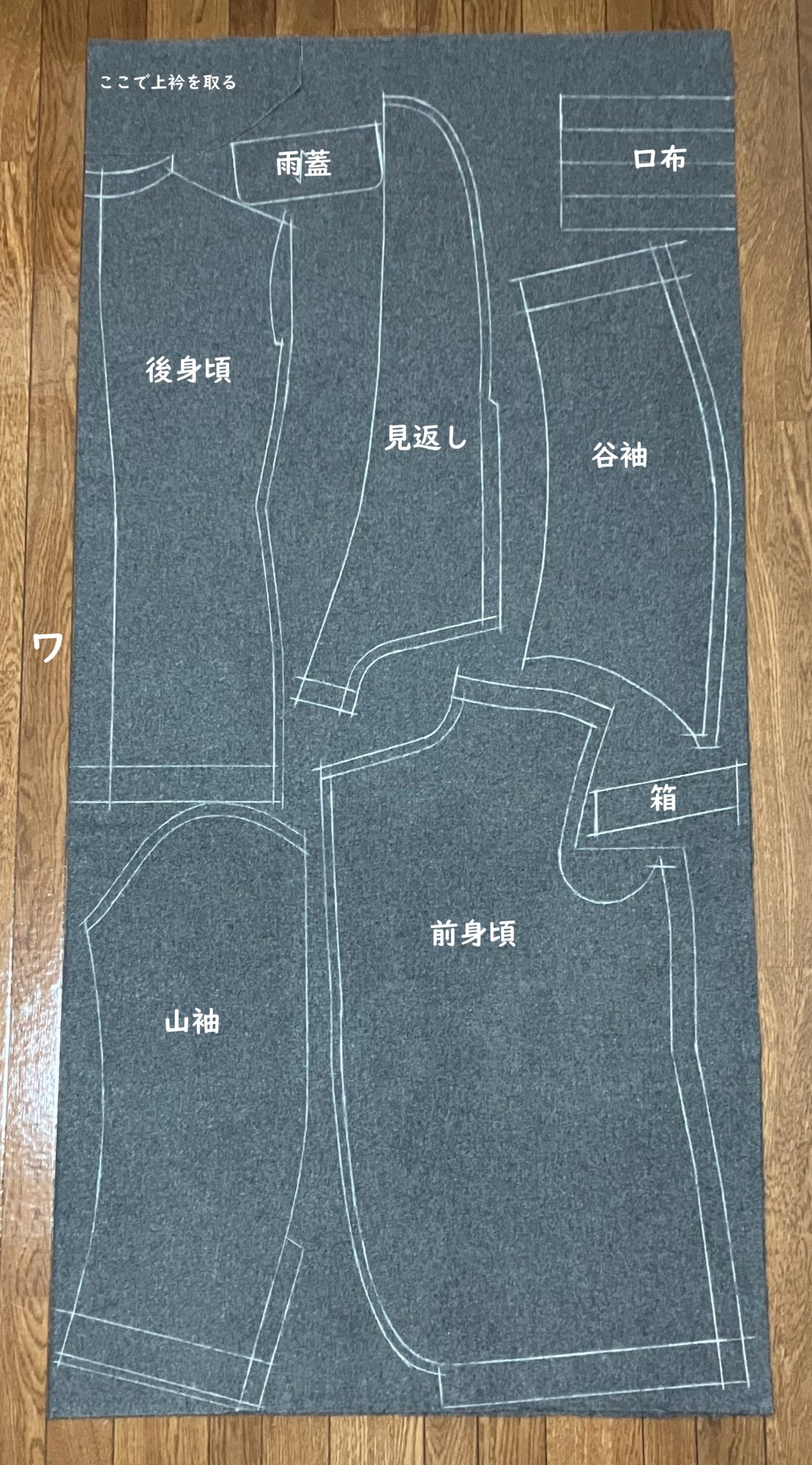
A layout for a jacket
This is one jacket’s worth. Besides the forepart, the back, the facing, the top sleeve and the under sleeve, the small pieces come from the same cloth: top collar, flaps, pocket welt strips. The large pieces go down first, and the small ones go into the gaps left over.