This page was originally written in Japanese and has been translated into English. Some photographs retain Japanese annotations; the text and captions explain the construction in English.
Drafting
How a pattern is made: proportional drafting, block-based drafting and draping, and what each one takes its shape from.
How a pattern is made, and how to read the lines of a finished draft.
How a pattern is made
One kind of method draws lines on flat paper; the other shapes the cloth on a form. The flat methods divide again into proportional drafting, which works straight from the measurements, and block-based drafting, which derives the pattern from a block made once and kept.
Proportional drafting
Each dimension is found from the measurements by a formula settled in advance, and the pattern is made flat.
In jacket drafting, shoulder dimensions can be derived in proportion to the chest in a breast-measure system, or taken directly to account for posture and build in a short-measure system.
The formulas settle only the dimensions. To place a point and draw a line, the relations between points and lines are needed as well: from where it is measured, in which direction, which line it is square to, which two lines it crosses. In proportional drafting both the dimensions and the relations are settled in advance.
What the books actually write out, though, is usually only how the dimensions are found. The directions and positions are left unwritten, and the reader is expected to take them from the worked example printed in the same book.
Since horizontal and vertical lines are drawn from the full length, the back waist length, the scye depth, the breast, the back width and the across breast, the whole draft comes out boxed in by horizontals and verticals.
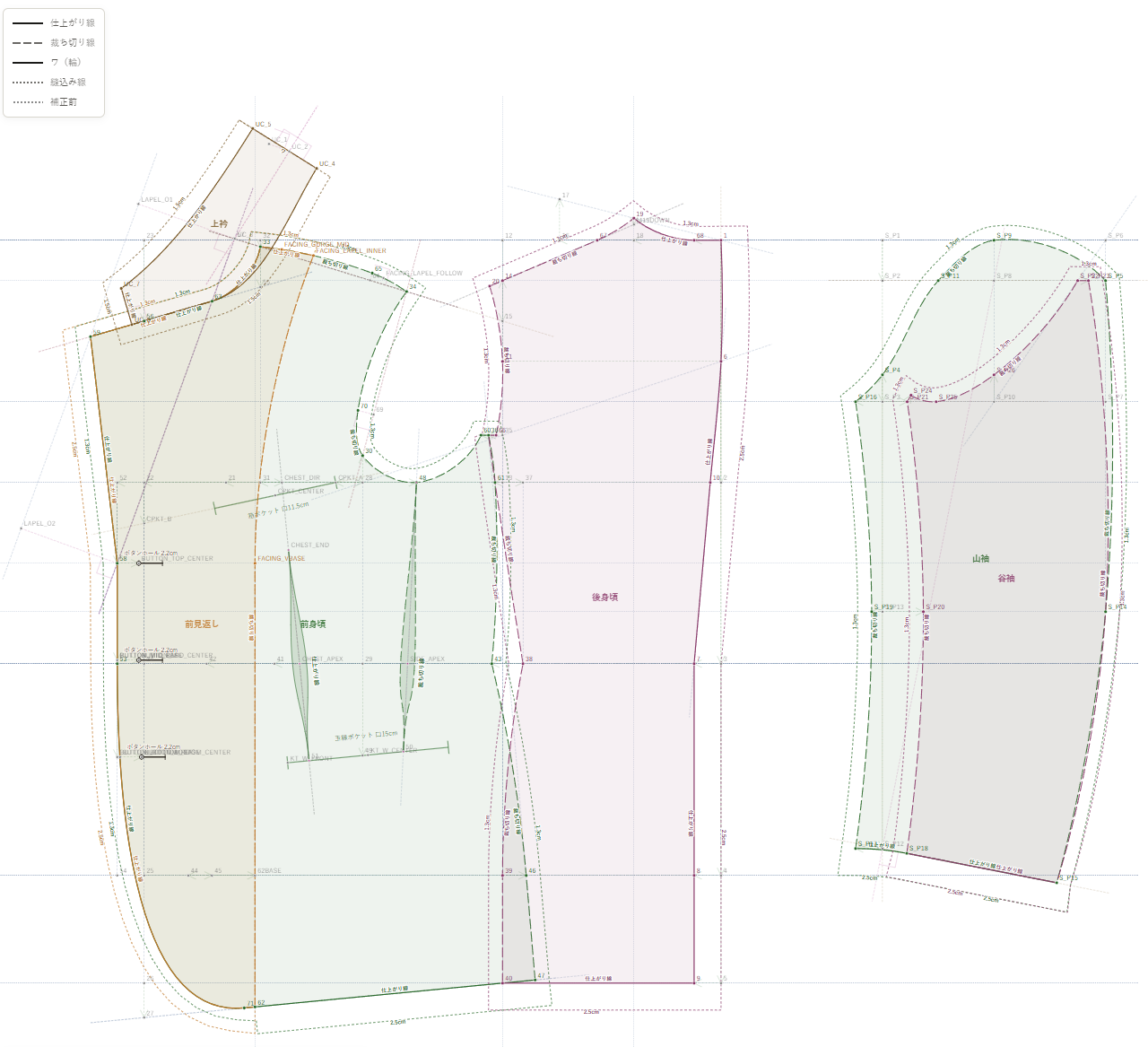
Alterations are made in a fixed order: draft the whole thing to the measurements as given, then apply the alteration to the finished draft.
This is a kind of parametric model, of the sort used in mechanical and architectural design. The steps printed in a cutting book correspond to the history of a parametric CAD model.
Block-based drafting
A block is first made from the measurements by proportional drafting, and various garments are then drafted flat by deriving them from that block.
The block is corrected to the figure of the wearer, and the garment is drafted on that basis. The blocks used are the men’s block and the women’s block. The method is used for garments worn on the upper body.
Draping
Cloth is laid directly on a form that follows an average figure, and the shape of the garment is built up by pinning. It is also called modelling on the stand.
Because the shape is made on the form, shapes that are hard to reason about on paper can be arrived at directly. The shape is marked, the cloth is laid flat again, and a flat pattern is taken from it.
What men’s tailoring uses
Men’s tailoring mainly uses proportional drafting. Every draft on this site is made that way.
Block-based drafting is found before 1960 as well, but mostly for women’s clothes. A men’s draft made with block-based drafting appears in 『紳士服全集』(Sumiko Sawano 1948).
Drafts for each garment are here.
The lines of a draft
Finished lines and cutting lines
An outline from a flat draft is of two kinds: one that includes the seam allowance and one that does not. The first is the cutting line, the second the finished line.
Which lines are which differs between sources. As far as this site has checked, the division below is the common one. It is only one example; always check the book you are working from.
| Garment | Finished line | Cutting line |
|---|---|---|
| Coats (jacket, overcoat) | Front edge, bottom, neck line, collar end, back centre, chest dart, outline of the top collar, cuff | Scye (both body and sleeve), side seam, side dart, inside and outside seams of the sleeve, shoulder |
| Trousers | Top edge, front fork, back fork, bottom | Side seam, inside leg |
| Waistcoat | Back centre, bottom, collar end, front edge, chest dart | Side seam, scye, shoulder |
How much the seam allowance is
The seam allowance is drafted at ¼ inch (about 7mm). The drafts came from imperial measure.
A finished line carries this seam allowance and the inlay.
Related pages
- Comparing Sack Coat Drafts (Ease, Scye Depth, Back Neck)Sack coat drafts from prewar and postwar Japanese cutting books, drawn to the same measurements to compare their ease, scye depth, back neck and other features across the period.
- Details of TrousersTurn-ups or plain bottoms, how the waistband is taken, the top of the back, the back strap and the belt loops.
- Short-measure DraftingHow scye depth sets the B line, and how strap, over-shoulder and blade measurements determine the neck point, shoulder and distribution of width between front and back.
- Sleeves That Let the Arm Rise, and Sleeves That Do NotA shorter distance from the top of the top sleeve to the bottom of the under sleeve lets the arm rise more easily. The American and the English way of drafting, and the trade-off between movement and appearance.
- The Draped Sack CoatThe draft of a draped sack coat, which leaves fullness over the chest, laid against the plain sack coat of the same book. How the width is divided, the ease, where the neck point sits, the shoulder and the scye.
References
- Japan (1948) 『紳士服全集 (文化洋裁研究講座)』 服装文化協会 Catalogue recordTransmission service