This page was originally written in Japanese and has been translated into English.
Drafting
The draft of a single-breasted waistcoat: forepart and back.
This is the draft of a single-breasted waistcoat. The forepart and the back are cut.
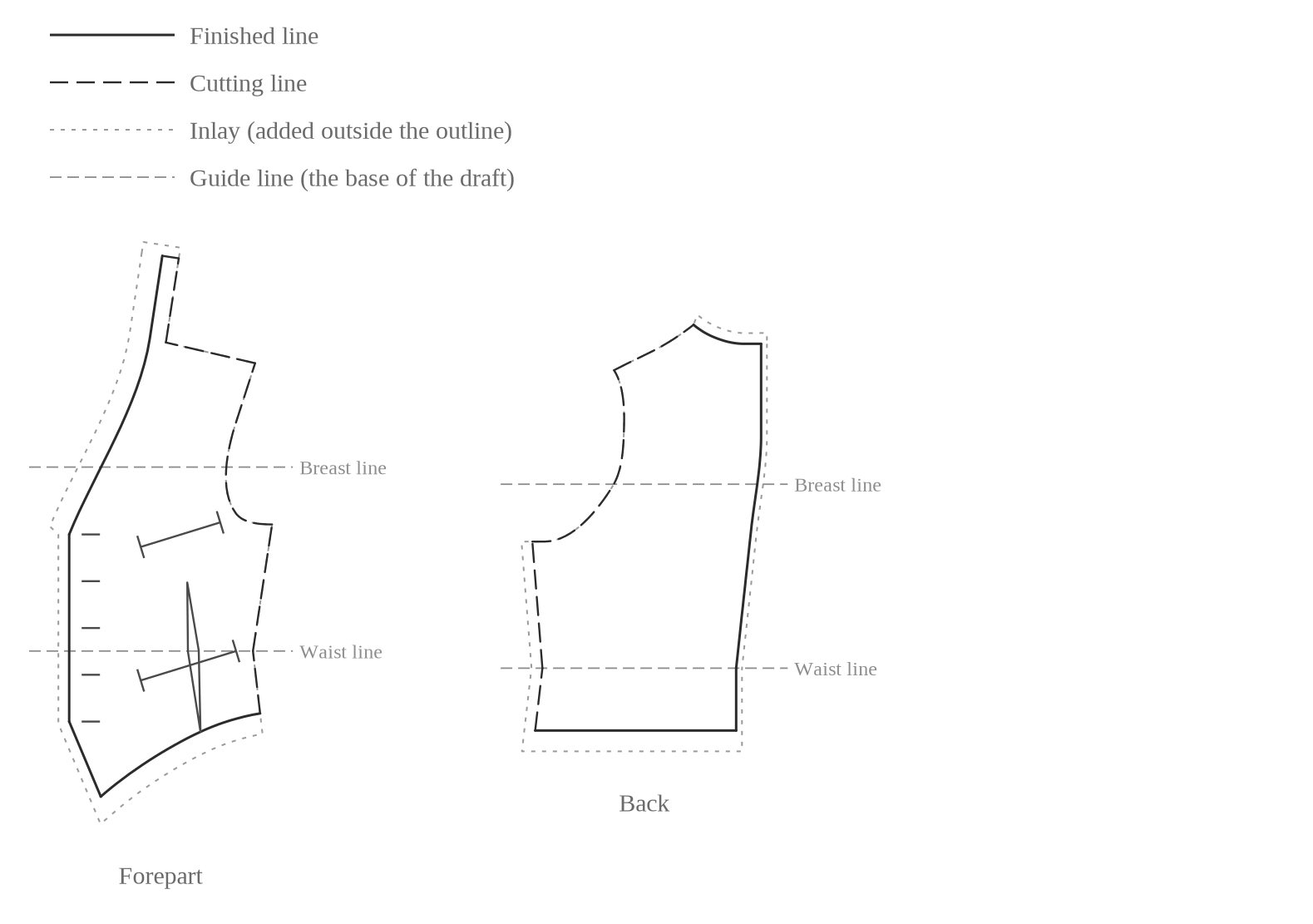
The solid and broken lines in the figure above mean the following.
| Line | Meaning |
|---|---|
| Solid | The finished line, where the pieces are seamed. It does not include the seam allowance |
| Broken | The cutting line: the finished line plus the seam allowance, usually ¼ inch (about 7mm) |
The inlays drawn in the figure are a guide. Some sources give figures for them, but what is drawn here does not follow any one of them. How much is left on which line is a matter of custom and taste.
On the front line from the top button to the neck point, however, an inlay of at least 2.5cm is always taken, because it is turned back on the finished line to form the facing.
How the back neck is taken
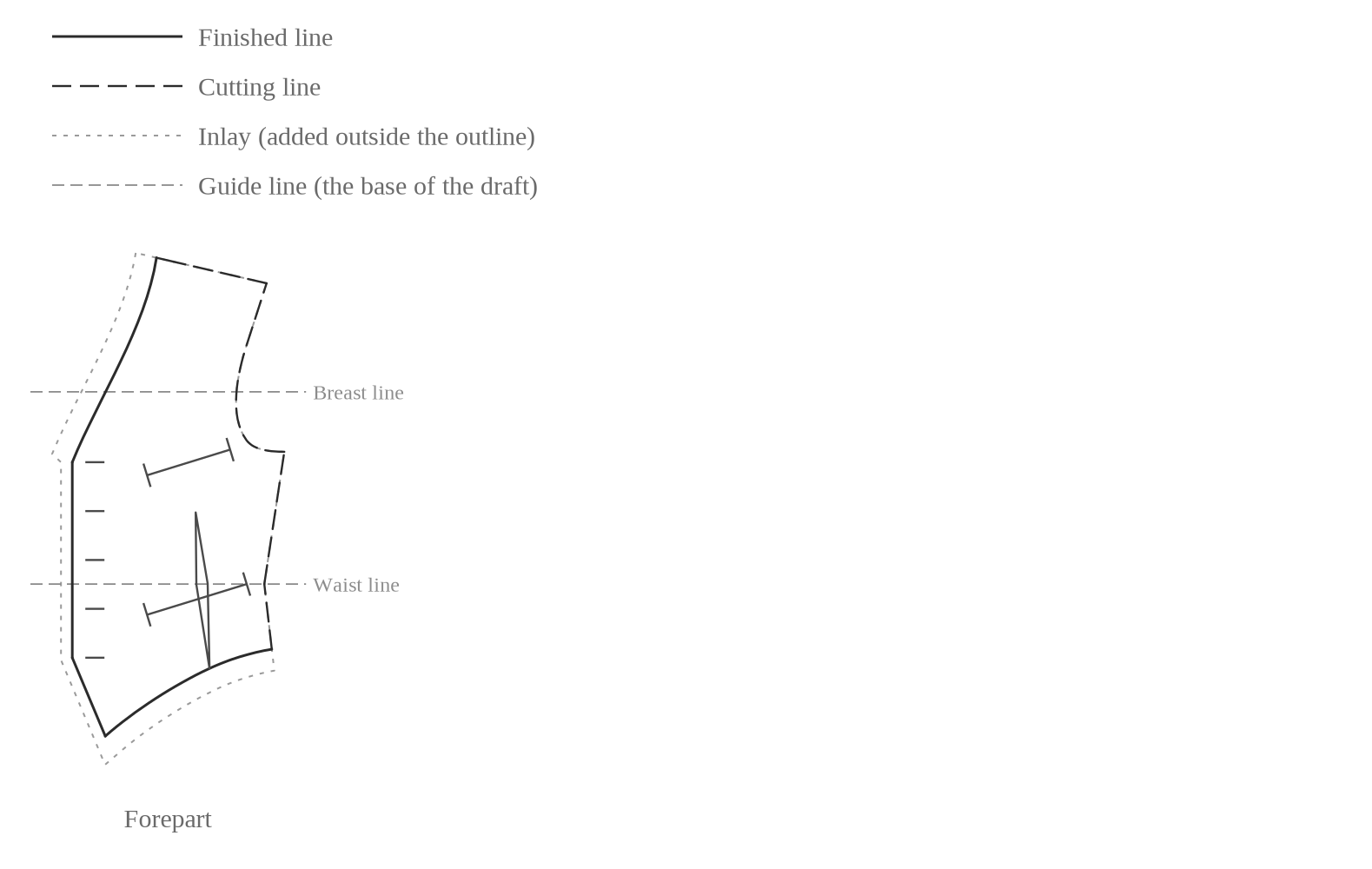
The back neck piece is either cut in one with the forepart, or cut as a separate piece. The figure above has it separate, so that the line from the neck to the front edge runs unbroken.
Cut in one, the forepart takes this shape.
The breast dart
How much the breast dart takes up depends on the draft; about 1.3cm when finished is the usual guide.
The outside pockets
The outside pockets are welt pockets. The breast pocket is about 10cm across the opening, the waist pockets about 12cm.
The inside pocket
One inside pocket goes behind the left front, as an inside breast pocket or a patch pocket. It sits a few centimetres below the breast pocket on the face, and is 15 to 16cm across the opening.
Drawing in the back
The waist of the back is drawn in either with a back strap, or with a waist dart taken in the back itself. The draft on this page uses the first, and has no dart in the back.