This page was originally written in Japanese and has been translated into English.
Details of Trousers
Turn-ups or plain bottoms, how the waistband is taken, the top of the back, the back strap and the belt loops.
The bottom
Trousers are made either without a turn-up at the bottom, or with one.
| Name | Worn with | |
|---|---|---|
| With a turn-up | Turn-up, double | A suit |
| Without | Plain, single | Formal dress such as a frock coat or a morning coat |
That was how the two were used from the 1920s to the 1950s.
Drafting the bottom
With a turn-up, the bottom line is drawn level.
Without one, the front is raised at its centre by ½ inch (1.3cm) to ¾ inch (1.9cm), and the back is dropped at its centre by ½ inch (1.3cm) to 1 inch (2.5cm). The front rises a little and the back falls: what is called the morning cut.
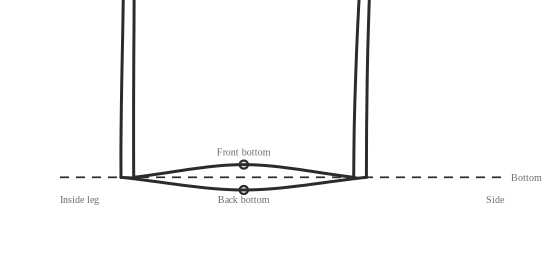
The depth of the turn-up
It is a matter of design, but about 1¾ inches (4.4cm) is the usual guide.
The waistband
The waistband is either cut from a separate piece, or cut in one with the body. Cut in one is seen on trousers with no pleat or one pleat; with two pleats it is mostly separate.
The band is about 1½ inches (3.8cm) wide.
The top of the back
Before the 1930s there are trousers cut high at the centre of the top of the back, a design that assumes braces. It puts the suspender buttons at the back high up.
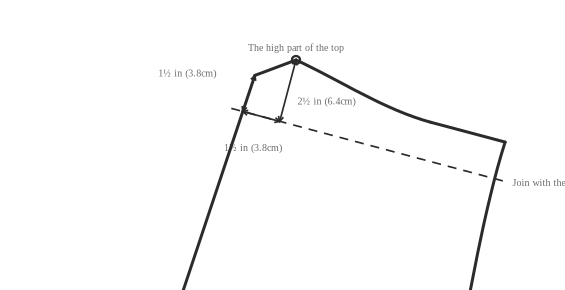
The back strap
A back strap is sometimes set at the back. The waist is then given about 1 inch (2.5cm) of ease on each half at the back centre, and the strap draws it in. By about 1948, though, the back strap was going out of use(Keiichi Kimura, Masami Matsubara 1948, p.250).
The belt loops
The top of the belt loop sits at the join between the waistband and the body where the band is separate, and at the height of the waist stitching where the band is cut in one. That height is the waist of the draft, and it is where the belt is worn.
References
- Japan (1926) 『裁断研究』 日本毛織物新報社 Catalogue recordTransmission service
- Japan (1935) 『阿部スタンダード式ズボン類裁断全書』 メインハウス Catalogue recordTransmission service
- Japan (1948) 『図解紳士服全書』 生活研究社 Catalogue recordTransmission service
- Japan (1948) 『新撰現代洋服裁断製図集』 服装生活社 Catalogue recordTransmission service
- Japan (1948) 『テーラーズ・ハンドブック』 生活研究社 Catalogue recordTransmission service