This page was originally written in Japanese and has been translated into English. Some photographs retain Japanese annotations; the text and captions explain the construction in English.
Drafting
The draft of a pair of trousers: forepart and back.
This is the draft of a pair of trousers. The forepart and the back are cut, with extra length at the bottom for the turn-up.
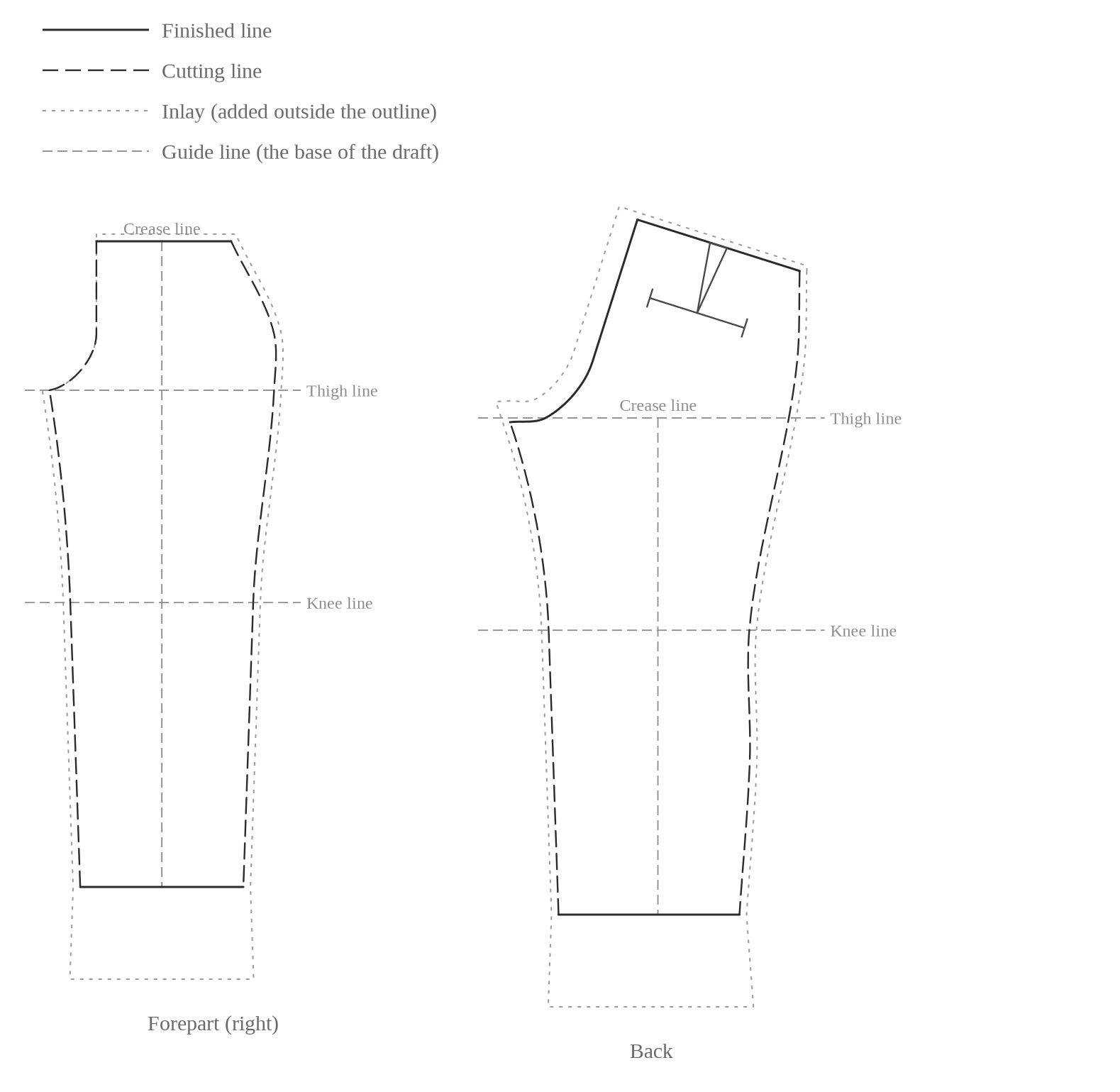
The solid and broken lines in the figure above mean the following.
| Line | Meaning |
|---|---|
| Solid | The finished line, where the pieces are seamed. It does not include the seam allowance |
| Broken | The cutting line: the finished line plus the seam allowance, usually ¼ inch (about 7mm) |
The seam allowance is what the seam itself takes; the inlay is spare cloth kept for future alterations.
The specification
These are the points that make up the specification of a pair of trousers. They are settled before cutting.
| Item | Choices |
|---|---|
| Number of pleats | None, one, two |
| Which way the pleats turn | Inwards, outwards |
| Fly front | Button fly, zip fly |
| Waistband | A separate band, or the body carried up to the top edge |
| Pockets | Side pockets and waist pockets, usually |
| Watch pocket | Sometimes on the right front |
| Bottoms | Plain, or with turn-ups |
| Back strap | Sometimes at the back centre of the waist |
The zip fly appears to have come in after the war.
The watch pocket holds a pocket watch. Where the waistband is a separate band, its opening is made in the seam of the band.
For trousers that will be washed frequently, the raw edges are enclosed within the seam allowances throughout.
The draft
The forepart
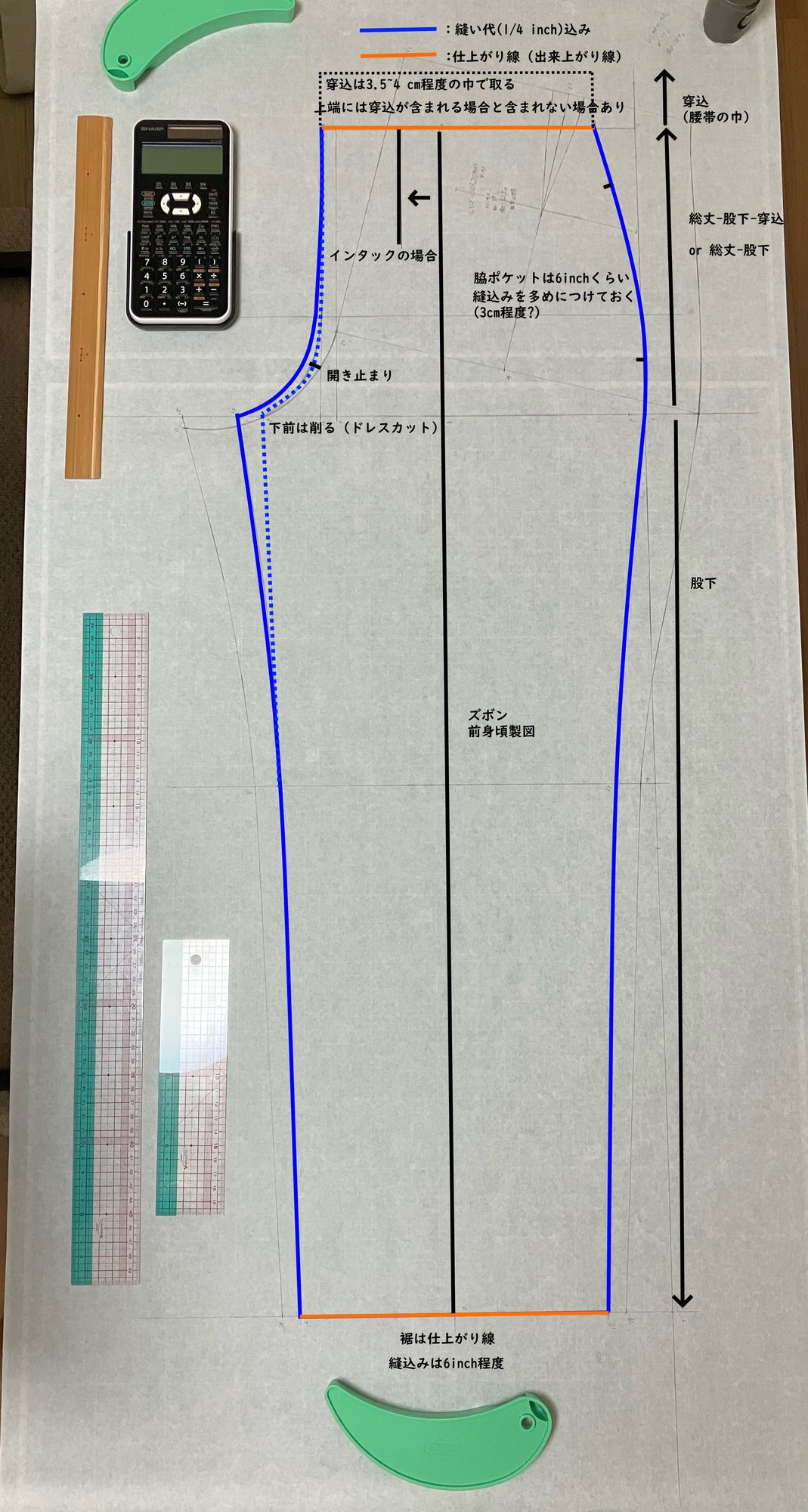
The waistband is 3.5 to 4cm deep. It is either included at the top edge or not; where it is not, the waistband is a separate band.
Extra inlay is left where the side pocket falls. The opening is about 6 inches (15cm), the inlay about 3cm.
The right front is shaved back very slightly at the front edge, which is called the dress cut. This allows room for the wearer’s genitals on the left; without the adjustment, they push the right front sideways and leave excess fabric there.
The bottom is drawn at the finished line. How much is added there depends on whether the bottoms are plain or turned up. Allowing 7cm inside, plain bottoms need 7cm; turn-ups need that plus twice the depth of the turn-up. With a turn-up of 4cm, 7 + 4 × 2 = 15cm, which is the 6 inches in the figure.
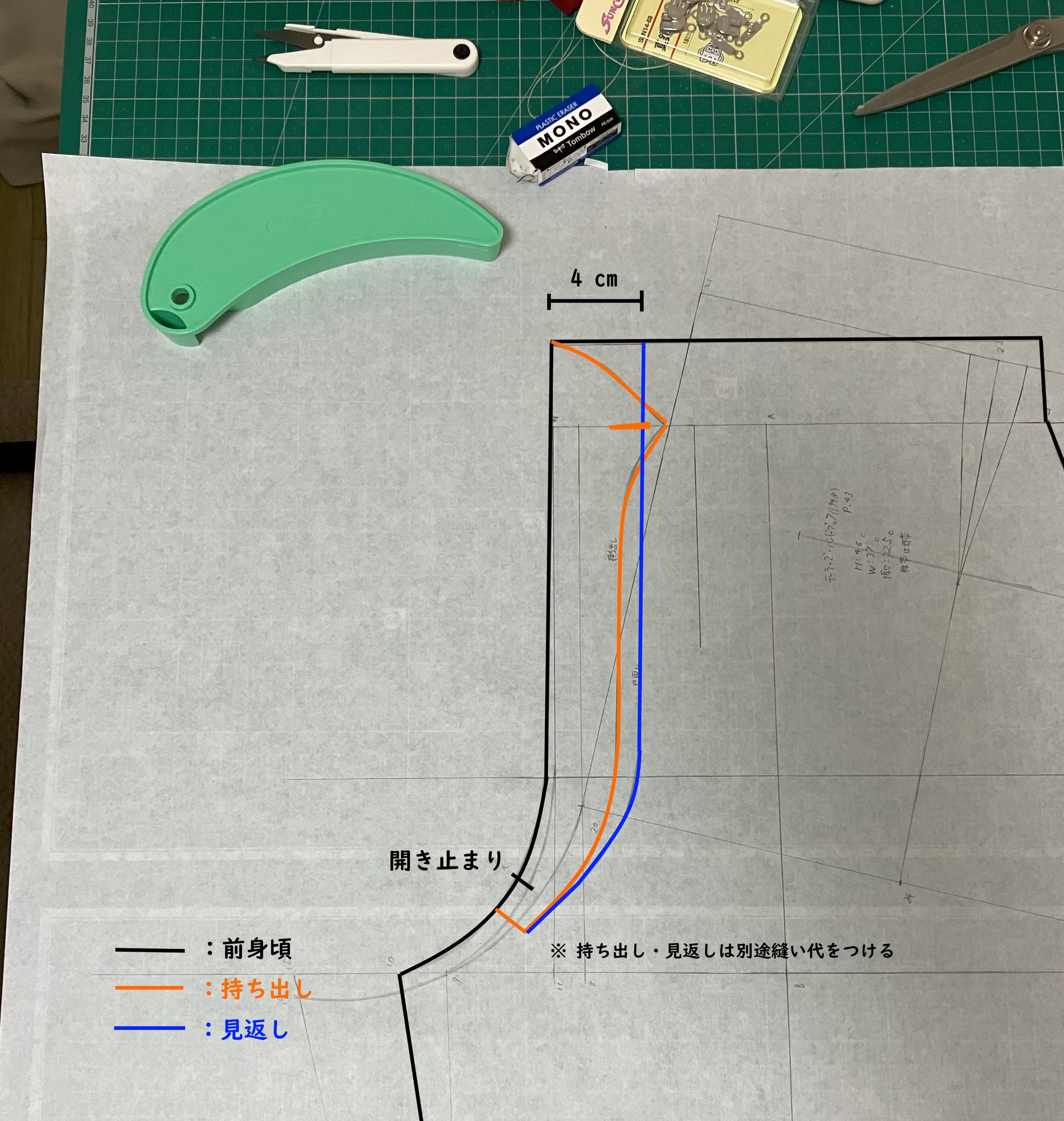
The fly shield and the facing
The fly shield and the facing are drawn to the front edge of the forepart. Both take their own seam allowance.
The back
The dart takes up about 1 inch. It is not drawn as a plain V. Older drafts mostly give one dart; two are seen now and then.
The back pocket is about 6 inches (15cm) across the opening. The bottom takes the same addition as the forepart.
At the top of the back rise there is sometimes an allowance for drawing the waist in with a back strap.
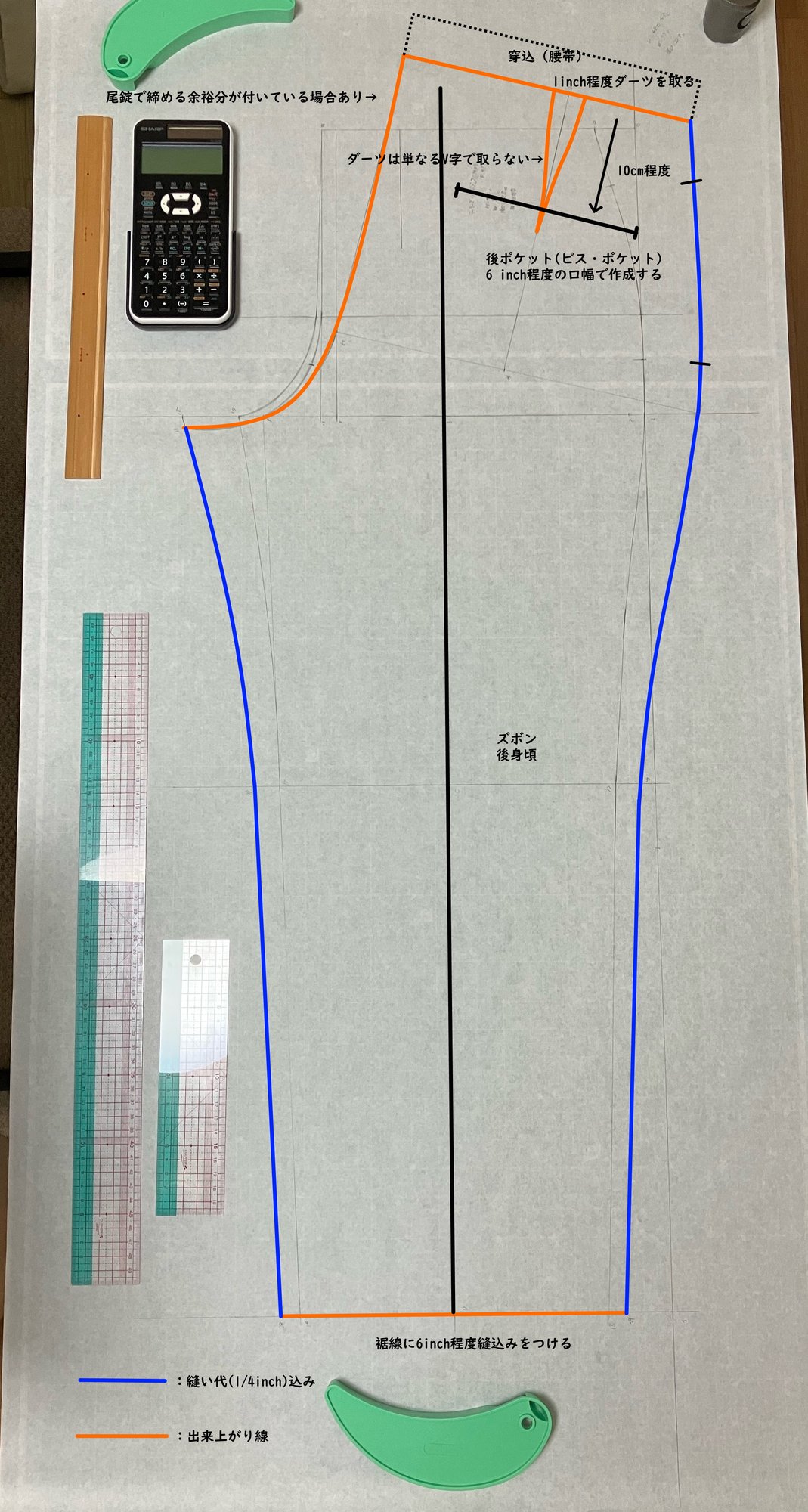
The inlays drawn in the figure are a guide. Some sources give figures for them, but what is drawn here does not follow any one of them. How much is left on which line is a matter of custom and taste.
References
- Japan (1922) 『洋服裁縫全書ズボンの手引』 福富商店 Read at the NDL Digital Collections Online
- Japan (1935) 『阿部スタンダード式ズボン類裁断全書』 メインハウス Catalogue recordTransmission service
- Japan (1948) 『図解紳士服全書』 生活研究社 Catalogue recordTransmission service
- Japan (1948) 『テーラーズ・ハンドブック』 生活研究社 Catalogue recordTransmission service
- Japan (1959) 『男子服裁縫』 文化服装学院出版局 Catalogue recordTransmission service