This page was originally written in Japanese and has been translated into English. Some photographs retain Japanese annotations; the text and captions explain the construction in English.
Sleeves That Let the Arm Rise, and Sleeves That Do Not
A shorter distance from the top of the top sleeve to the bottom of the under sleeve lets the arm rise more easily. The American and the English way of drafting, and the trade-off between movement and appearance.
The sleeve of a uniform, and the sleeve called the English one, are drafted with a low sleeve head and a shallow scye on the under sleeve. The distance from the top of the top sleeve to the bottom of the under sleeve then comes out 1.3 to 3cm shorter than in the American sleeve.
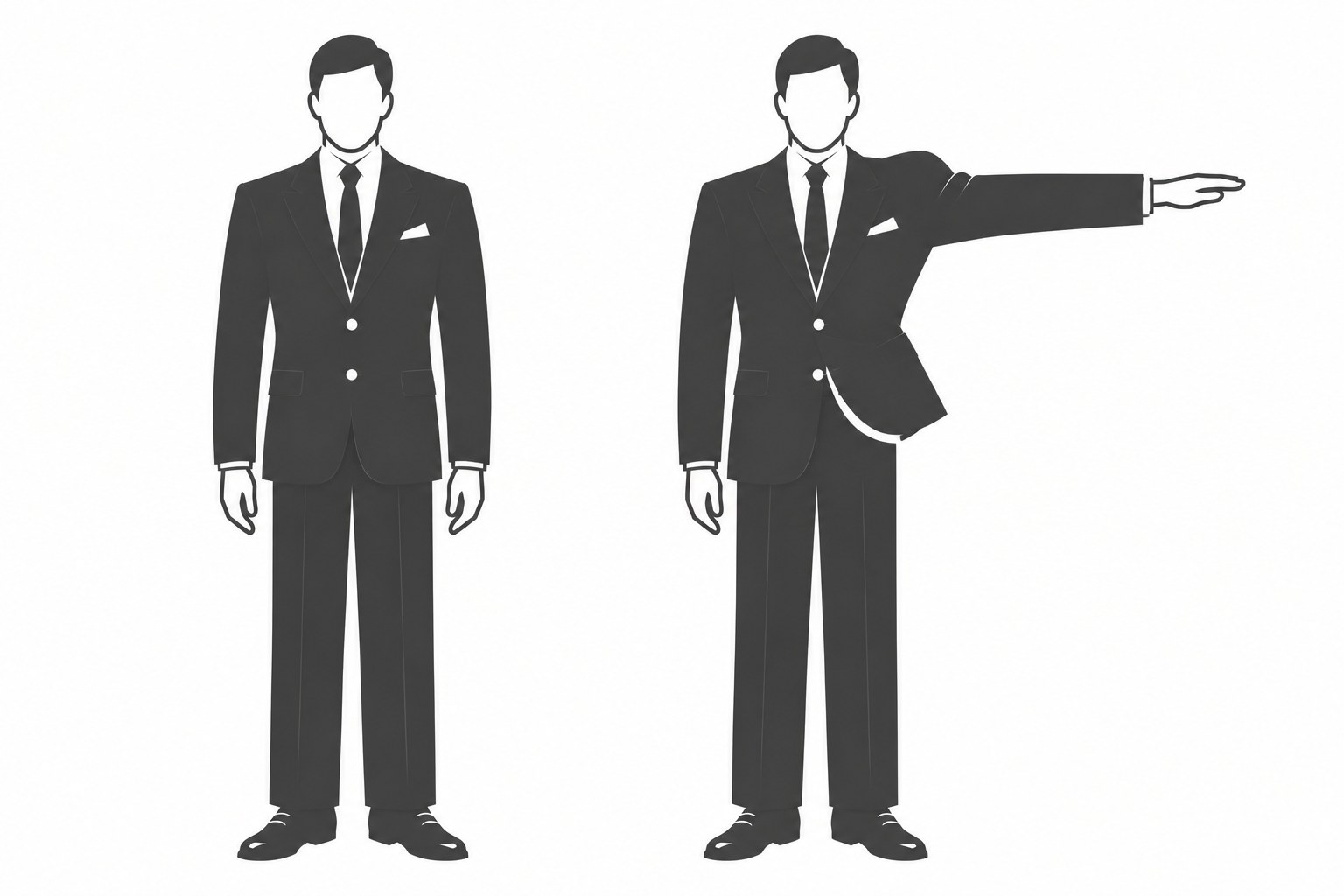
The shorter that distance, the more cloth is left in the under sleeve, and the more easily the arm rises; the sleeve head gets in the way less. It is the make used for clothes worn where the arm is raised often, as in saluting. The English sleeve is mostly used on a stand-collar coat.
The distance from the sleeve head to the bottom
Measured off the drafts in the sources, that distance usually comes to the following, against the scye, which is the drafting power. It is not a figure settled before drafting; it is what the finished drafts measure.
| Draft | Distance from head to bottom | Shape of the sleeve |
|---|---|---|
| American | Scye ÷ 3 | High sleeve head, deep scye on the under sleeve |
| English, the national uniform, army uniform | Scye ÷ 3 − ½ to 1 inch | Low sleeve head, shallow scye on the under sleeve |
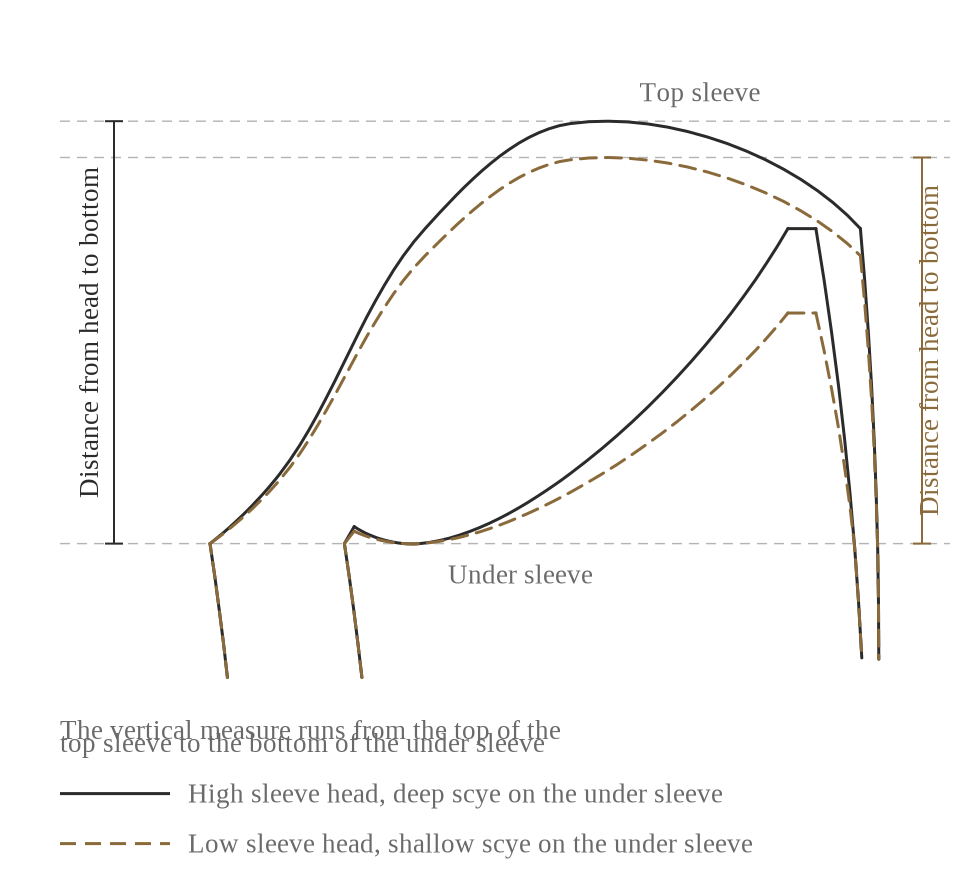
How the sleeve is set, and freedom of movement
A short distance means that the sleeve is set rather sideways. The sleeve of a dress shirt is like that. A long distance means that it is set rather downwards.
A sleeve set downwards looks well while the arm hangs. A sleeve set sideways moves easily, but with the arm down there is not enough cloth near the head, and excess fabric under the sleeve forms wrinkles. Movement and appearance are a trade-off.
The armhole
How easily the arm rises is not settled by the sleeve alone. It assumes that the armhole of the body is made to the root of the arm, and the scye depth in particular has to agree. Held close against the root it binds, so it only follows the shape.
The shallower the scye depth, the more room there is under the arm, and the more easily the arm rises. The scye depths of the breast-measure system are compared in Comparing sack coat drafts.
Where movement matters, the armhole is best made small, following the arm. Made large it looks neat while the arm hangs, but when the arm rises there is not enough cloth, the body is dragged with it, and the arm will not go up.

References
- Japan (1940) 『洋服の裁断と補正』 洋装研究社 Catalogue recordTransmission service
- Japan (1941) 『正しき国民服の作り方』 洋装社 Catalogue recordTransmission service
- Japan (1948) 『図解紳士服全書』 生活研究社 Catalogue recordTransmission service
- Japan (1949) 『裁断の基礎研究』 洋装社 Catalogue recordTransmission service