This page was originally written in Japanese and has been translated into English.
Short-measure Drafting
How scye depth sets the B line, and how strap, over-shoulder and blade measurements determine the neck point, shoulder and distribution of width between front and back.
The short-measure system uses measurements around the shoulders and underarms, as well as the chest, to establish the balance of the body draft. It accounts for posture, shoulder slope and the distribution of width between front and back, which chest proportions alone cannot describe.
Other methods, including long-measure systems, also use measurements to account for posture.
The three-button single-breasted sack coat in Keiichi Kimura’s 『裁断研究』 (1926) provides the example here(Keiichi Kimura 1926). The comparisons show how strap, over-shoulder, blade and scye depth affect the draft.
Measurements and their roles
Scye depth sets the height of the B line, or breast line. Strap, over-shoulder and blade measurements then determine the neck point, shoulder and distribution of width relative to that line.
| Measurement | Route | Role in the draft |
|---|---|---|
| Scye depth | Vertically from the base of the neck at the back to underarm level | Height of the B line and depth of the armhole |
| Strap | From the base of the neck at the back, through the neck point, to the front of the scye (armhole) at B-line level | Height of the neck point above the B line |
| Over-shoulder | From centre back at B-line level, over approximately the middle of the shoulder, to the front of the scye | Shoulder slope and height of the shoulder tip |
| Blade | From centre back, around the side of the body to the front of the scye, at B-line level | Distribution of width between front and back |
The neck point (NP) is at the side of the base of the neck, where the shoulder line meets the neckline. Scye depth is a vertical distance; strap, over-shoulder and blade follow the surface of the body and share the same reference point at the front of the scye.
How the measurements shape the draft
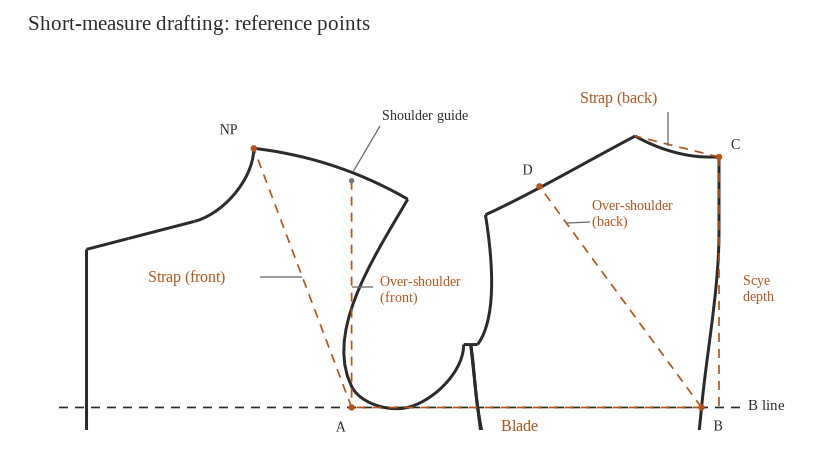
Allowances are added when transferring body measurements to the draft. Strap and over-shoulder are divided between front and back: the back section is subtracted, leaving the length used at the front.
| Measurement | Application in the draft |
|---|---|
| Scye depth | Depth from C to the B line |
| Strap | The remaining length, after subtracting the back section, sets A–NP and therefore the height of NP |
| Over-shoulder | The remaining length, after subtracting B–D, locates a shoulder guide point above A |
| Blade | Width of B–A |
The front shoulder runs from NP towards the guide point. The back shoulder length determines where the front shoulder tip falls along that direction.
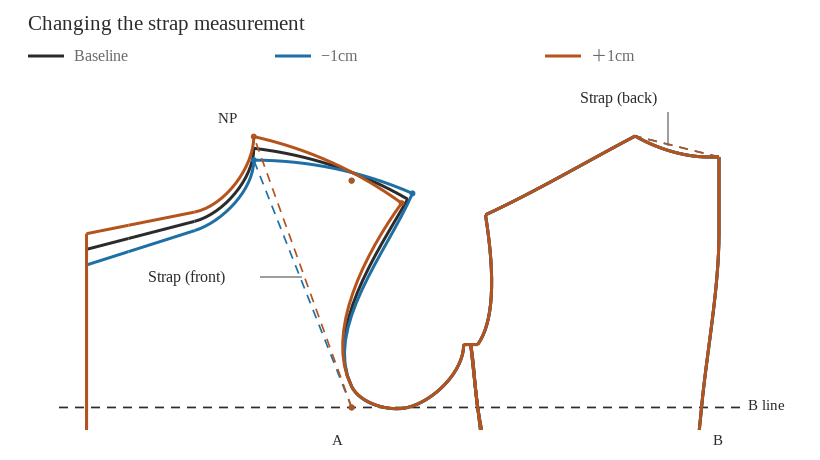
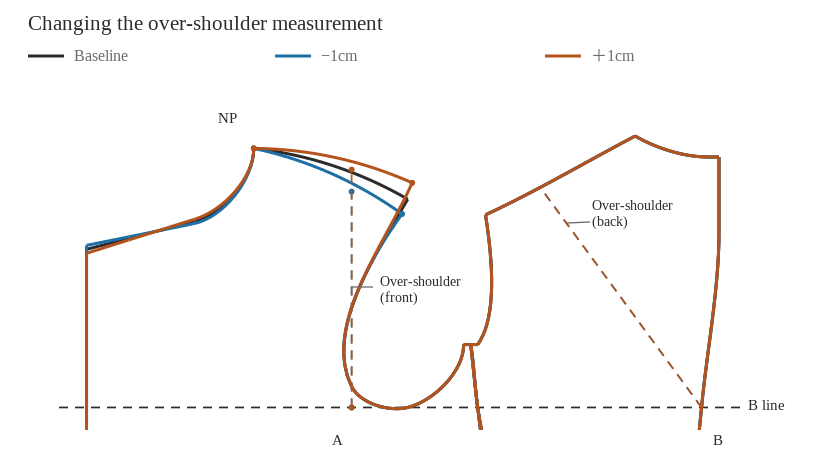
The comparisons use a strap of 30.5cm, an over-shoulder of 43cm and a blade of 28cm. Only one measurement changes at a time, by ±1cm. Chest 91.5cm, waist 81.5cm, seat 94cm, back waist length 40.5cm, full length 71cm and scye depth 21.5cm remain fixed.
Strap — neck-point height
A longer distance from A to NP raises NP; a shorter distance lowers it. With the over-shoulder measurement fixed, the shoulder guide point stays in place, so the shoulder slope also changes.
The strap also reflects neck posture. A more upright neck is expected to give a longer strap measurement.
Over-shoulder — shoulder slope
With the strap fixed, NP stays in place. A longer over-shoulder measurement raises the guide point and shoulder tip; a shorter measurement lowers them.
Blade — distribution of width
A longer blade measurement widens B–A. Centre front remains fixed by the chest measurement, so the front section from A to centre front becomes narrower. A shorter blade measurement does the reverse.
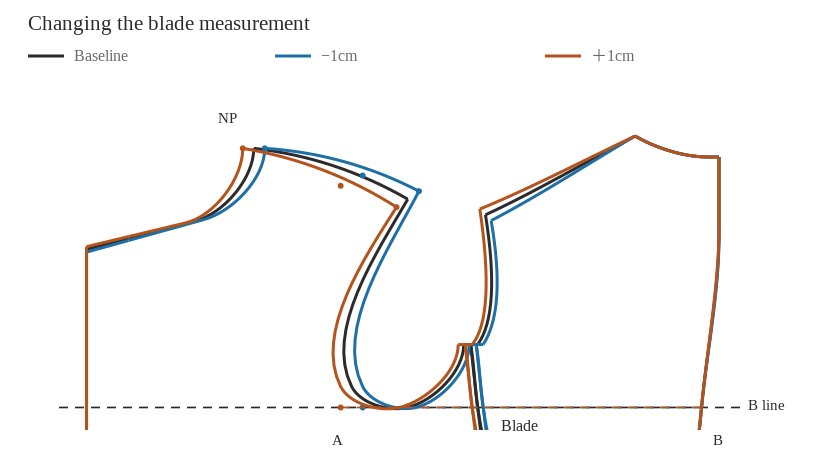
B–A includes the armhole region as well as the back width.
Posture, measurements and the draft
With scye depth and chest size held constant, the relationships can be set out as follows.
| Posture or build | Measurement tendency | Change in the draft |
|---|---|---|
| Stooping figure | Shorter strap and over-shoulder | Forepart shorter relative to the back |
| Erect figure | Longer strap and over-shoulder | Forepart longer relative to the back |
| Square shoulders | Greater over-shoulder relative to the strap | Higher shoulder tip |
| Sloping shoulders | Smaller over-shoulder relative to the strap | Lower shoulder tip |
| Broad back | Longer blade | Wider back section, narrower chest section |
| Prominent chest | Shorter blade | Wider chest section, narrower back section |
A posture label alone does not determine a measurement or an alteration. Length over the back and the distance around the body at B-line level are different dimensions; each follows its own measurement route.
Advantages and disadvantages compared with breast-measure drafting
| Effect | |
|---|---|
| Advantage | Posture, shoulder slope and the distribution of chest and back width can be incorporated into the initial draft, even for figures with the same chest size |
| Disadvantage | Measurements require accurate reference points, including the front of the scye and centre back at B-line level |
Underarm height and the positions of these reference points must be identified accurately. Errors affect the strap, over-shoulder and blade measurements.
Applying the relationships to breast-measure alterations
When altering a breast-measure draft, thinking of differences from standard posture in terms of strap, over-shoulder and blade helps identify the direction of the alteration.
| Posture or build | Short-measure tendency | Direction of alteration |
|---|---|---|
| Stooping figure | Shorter strap and over-shoulder | Shorten the forepart relative to the back |
| Erect figure | Longer strap and over-shoulder | Lengthen the forepart relative to the back |
| Square shoulders | Greater over-shoulder relative to the strap | Raise the shoulder tip relative to NP |
| Sloping shoulders | Smaller over-shoulder relative to the strap | Lower the shoulder tip relative to NP |
| Broad back | Longer blade | Keep chest size unchanged; widen the back section at the B line and narrow the chest section |
| Prominent chest | Shorter blade | Keep chest size unchanged; widen the chest section at the B line and narrow the back section |
Use the B line, set by scye depth, to distinguish front and back balance, shoulder slope and width distribution. Check the amount of alteration at the fitting, including its effect on the adjoining shoulder and armhole.
See Measuring for the measurements in general, and Comparing Sack Coat Drafts for differences between breast-measure drafts.
References
- Japan (1926) 『裁断研究』 日本毛織物新報社 Catalogue recordTransmission service
- Japan (1934) 『短寸式裁断及補正書』 慶文社 Catalogue recordTransmission service