This page was originally written in Japanese and has been translated into English.
Comparing Sack Coat Drafts (Ease, Scye Depth, Back Neck)
Sack coat drafts from prewar and postwar Japanese cutting books, drawn to the same measurements to compare their ease, scye depth, back neck and other features across the period.
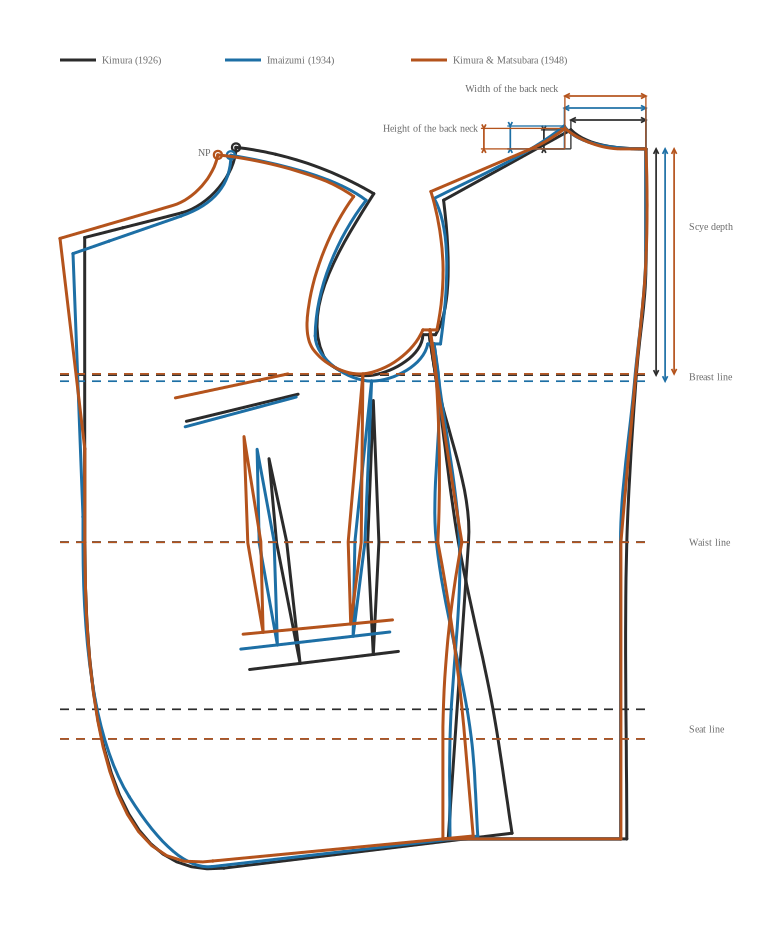
Sack coat drafts from prewar Japanese cutting books of 1926 and 1934 and a postwar book of 1948 are drawn to the same measurements. The three single-breasted coats are laid over one another to compare their ease and shape, showing what they share and how they differ across the period. For the scye depth and the back neck, formulas from other cutting books are also compared.
| Source | Draft used |
|---|---|
| 『裁断研究』(Keiichi Kimura 1926) | Single breasted, three buttons, notched lapel |
| 『裁断基礎研究』(Sue Imaizumi 1934), the draft contributed by Keiichi Kimura | Single breasted, two buttons, notched lapel |
| 『図解紳士服全書』(Keiichi Kimura, Masami Matsubara 1948) | Single breasted, three buttons, notched lapel |
The measurements used are: breast 90cm, waist 80cm, seat 94cm, full length 69cm, scye 45cm, inside sleeve length 41.5cm, the same figures in every draft. The drafts are laid over one another at their starting point, with the forepart and the back kept where each draft puts them. The number of buttons has not been made to agree; what is being looked at is the shape of the body.
How the width is divided
The breast line is divided into three: the across breast, the sleeve width and the back width. The sleeve width is bounded on each side by the vertical that touches the scye. The across breast is bounded in front by the centre front line, the back width at the back by the vertical through the starting point.
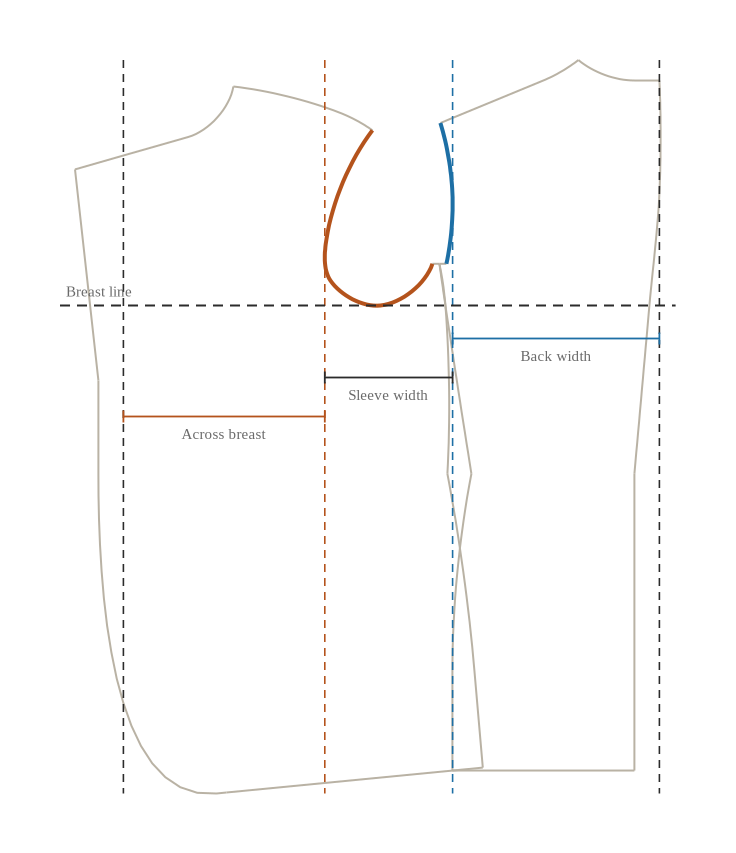
Drawn for a breast of 90cm, the figures come out as follows. No seam allowance has been taken off.
| Source | Across breast | Sleeve width | Back width | Ratio |
|---|---|---|---|---|
| Kimura (1926) | 19.4cm | 13.1cm | 19.8cm | 37 : 25 : 38 |
| Imaizumi (1934) | 19.4cm | 13.2cm | 19.9cm | 37 : 25 : 38 |
| Kimura & Matsubara (1948) | 20.1cm | 12.8cm | 20.7cm | 38 : 24 : 39 |
In all three the chest and the back come out near each other, the back a little the wider, and the sleeve width about two thirds of either. Roughly 37 : 25 : 38. In 『図解紳士服全書』 the back width and the across breast are taken from the figure, so the formula the book gives for reference was used: B/2 + B/3 + 1.3cm, which is 38.8cm at a breast of 90cm.
How the measures run as the breast changes is shown below.
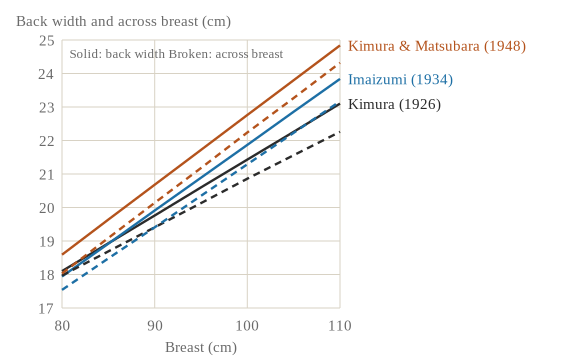
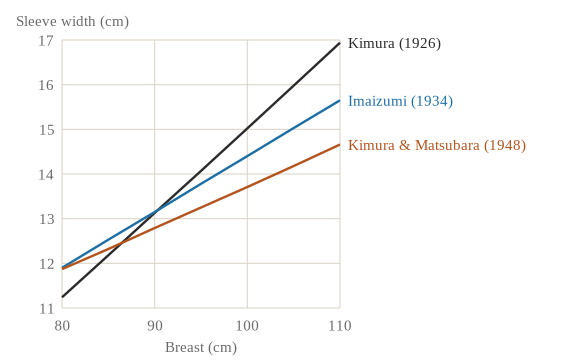
The back width and the across breast are close in all three, and at every breast Kimura & Matsubara (1948) is the widest. In every source the back width exceeds the across breast, by 0.1 to 0.8cm. In Kimura & Matsubara (1948) it holds at about 0.5cm whatever the breast; in Kimura (1926) it opens as the breast grows. The sleeve widths draw apart as the breast grows: at a breast of 110cm, Kimura (1926) gives 16.9cm and Kimura & Matsubara (1948) 14.7cm, a difference of 2.3cm.
Change the breast and the division moves with it. What moves is almost all sleeve width; the back width and the across breast only share out about a point between them, the other way about. From a breast of 80cm to 110cm, the back width and the across breast stay within 37 to 39% in all three.
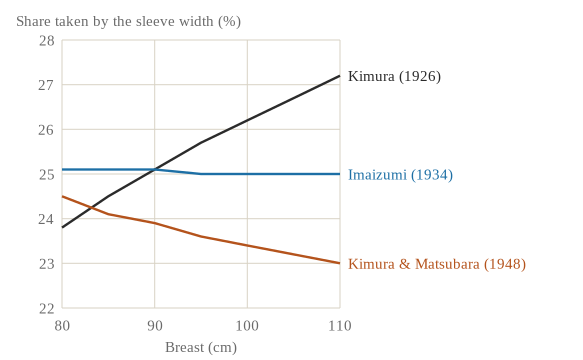
『裁断基礎研究』 divides the whole by proportion, so it holds at 38 : 25 : 37 whatever the breast. The other two carry constants in their formulas, so the division shifts: as the breast grows, Kimura (1926) gives more sleeve width and Kimura & Matsubara (1948) less.
Ease
The draft is measured right round and the measurement put in is subtracted. The side seam and the side dart are cutting lines, so a seam allowance of ¼ inch is taken off each. Over half the body, the equivalent of four seam allowances is deducted: two at the side seam and two at the side dart. The side dart does not reach the seat line, so there only the two seam allowances of the side seam are taken off.
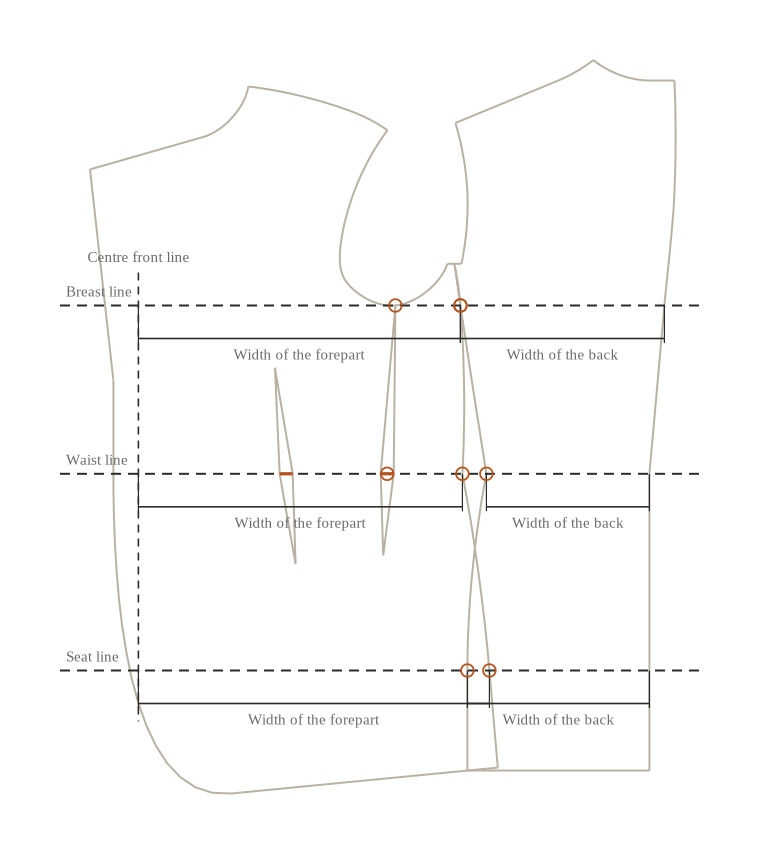
Drawn again from a breast of 80cm to 110cm, the ease hardly moves. For the two that do move, the values at 80cm and at 110cm are given.
| Breast line | Waist line | Seat line | |
|---|---|---|---|
| Kimura (1926) | +7.1cm | +8.9cm | +11.2 to 10.4cm |
| Imaizumi (1934) | +7.1cm | +4.6cm | +7.4cm |
| Kimura & Matsubara (1948) | +9.6cm | +6.5 to 6.8cm | +9.8cm |
At the breast, Kimura (1926) and Imaizumi (1934) agree, and only Kimura & Matsubara (1948) takes 2.5cm more. At the waist and the seat, Imaizumi (1934) is drawn in the closest and Kimura (1926) is the loosest.
In Kimura (1926) the side seam of the forepart widens towards the bottom, which gives the coat flare over the seat.
Scye depth
The depth from the starting point down to the breast line.
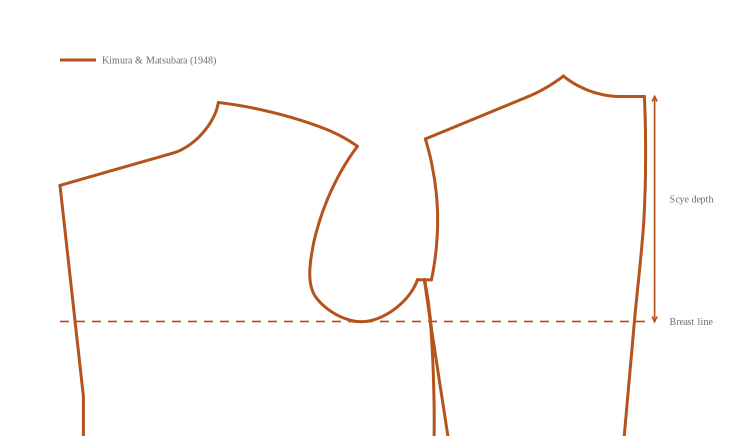
How it is found differs from book to book. Below, B is half the breast.
| Formula | Source |
|---|---|
| B/3 + 3 inches (7.62cm) | 『EO式洋服裁断法』(Eitaro Ota 1917), 『丸山式洋服裁断全書』(Kosaku Maruyama 1926), 『裁断研究』(Keiichi Kimura 1926), 『図解紳士服全書』(Keiichi Kimura, Masami Matsubara 1948) (which writes 7.5cm) |
| 3B/8 + 2¼ inches (5.72cm) | 『実用裁断』(Tsuramitsu Cho 1934), 『新撰現代洋服裁断製図集』(Torakichi Kikuchi 1948), 『テーラーズ・ハンドブック』(Masami Matsubara 1948) |
| 3B/8 + 2½ inches (6.35cm) | 『裁断基礎研究』(Sue Imaizumi 1934) |
| B/2 | 『男子服裁縫の要訣』(Akihiro Someba 1940) |
| B/3 + 8cm | 『図解背広講座』(Josuke Ebata 1961) |
B is multiplied by one of three fractions, 1/3, 3/8 or 1/2, and the larger the fraction the smaller the constant set against it. At a breast of 90cm (B = 45cm) they all fall between 22.5 and 23.2cm, but the further the breast moves from there, the more the fractions tell.
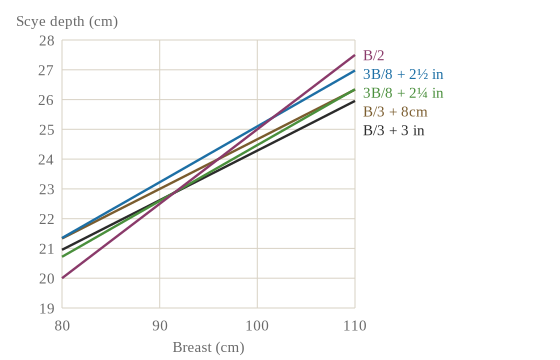
The spread of the five formulas is as follows.
| Breast (cm) | Largest (cm) | Smallest (cm) | Mean (cm) |
|---|---|---|---|
| 80 | 21.4 | 20.0 | 20.9 |
| 85 | 22.3 | 21.2 | 21.8 |
| 90 | 23.2 | 22.5 | 22.8 |
| 95 | 24.2 | 23.5 | 23.7 |
| 100 | 25.1 | 24.3 | 24.7 |
| 105 | 26.2 | 25.1 | 25.7 |
| 110 | 27.5 | 26.0 | 26.6 |
The scye line of the draft includes a seam allowance of ¼ inch (about 7mm). The depth actually measured from the starting point is the figure in the table plus that ¼ inch (about 7mm).
Where the neck point sits
The neck point of the forepart is looked at in two ways: where it sits across, and how high it sits.
Position across
Where the neck point falls within the across breast, taken as a proportion with the centre front line at 0% and the vertical touching the scye at 100%.
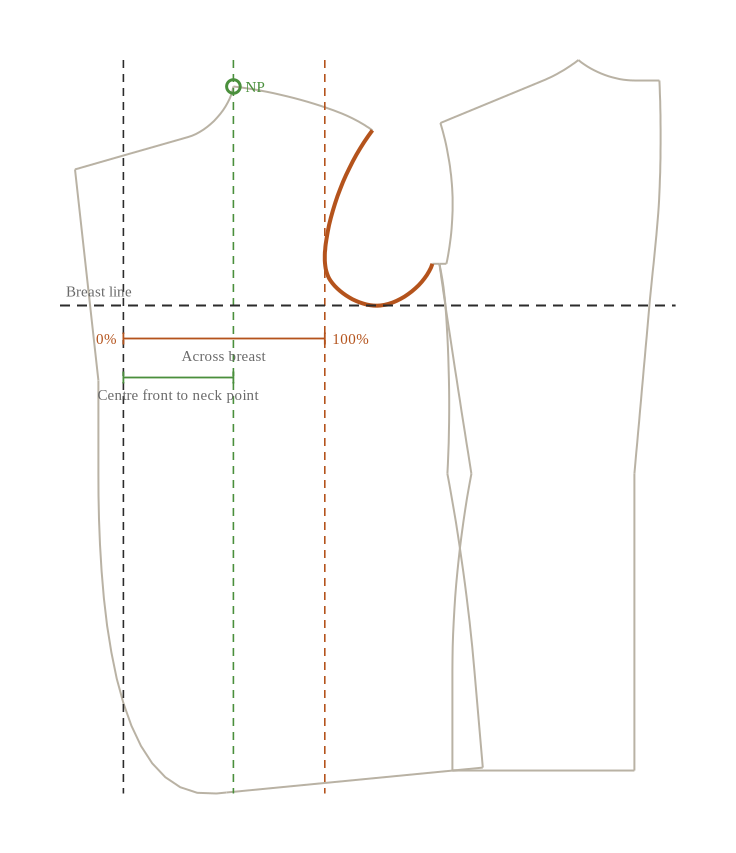
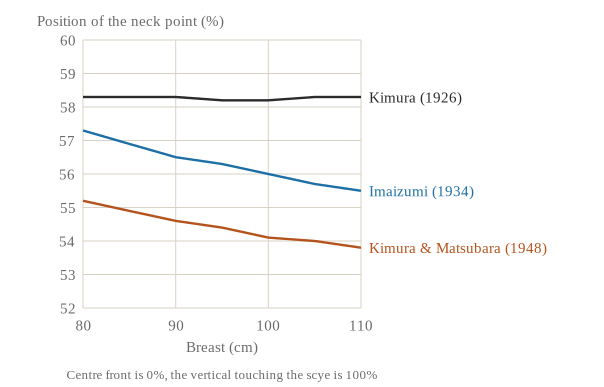
Where that proportion comes from is easier to see in the actual measures.
First, the across breast itself differs between the three. At a breast of 110cm it is 22.3cm, 23.2cm and 24.3cm, each about 1cm wider than the last. The distance from the centre front line to the neck point, on the other hand, is much the same, 12.9 to 13.1cm (at a breast of 90cm, 11.0 to 11.3cm, within 0.5cm).
The difference in the across breast therefore shows up entirely on the other side, from the neck point to the scye: 9.3cm, 10.3cm and 11.2cm at a breast of 110cm, again about 1cm apart.
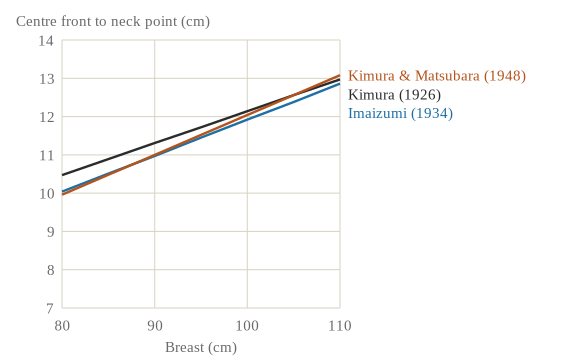
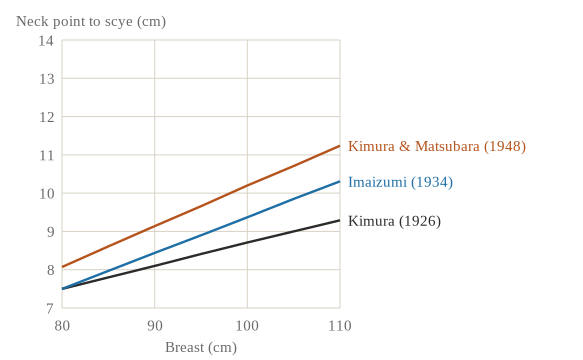
The two figures share the same scale up the side. On the left the three lines lie together; on the right they open as the breast grows.
Height
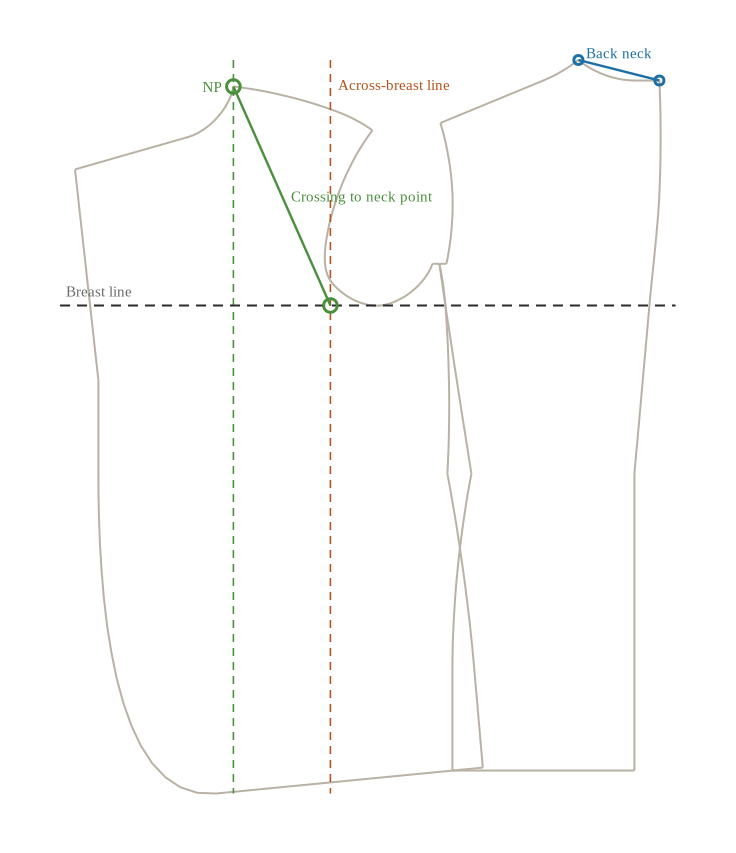
The distance from the point where the breast line meets the across-breast line — that is, where the chest ends at the front side — up to the neck point. The across-breast line is the vertical through the front limit of the scye of the forepart. Kimura (1926) gives this distance by formula, so it is measured straight.
| Breast (cm) | Kimura (1926) | Imaizumi (1934) | Kimura & Matsubara (1948) |
|---|---|---|---|
| 80 | 21.9 | 22.0 | 22.0 |
| 85 | 23.2 | 23.1 | 23.0 |
| 90 | 24.4 | 24.1 | 24.0 |
| 95 | 25.7 | 25.2 | 24.9 |
| 100 | 26.9 | 26.2 | 25.9 |
| 105 | 28.2 | 27.2 | 26.9 |
| 110 | 29.4 | 28.3 | 27.8 |
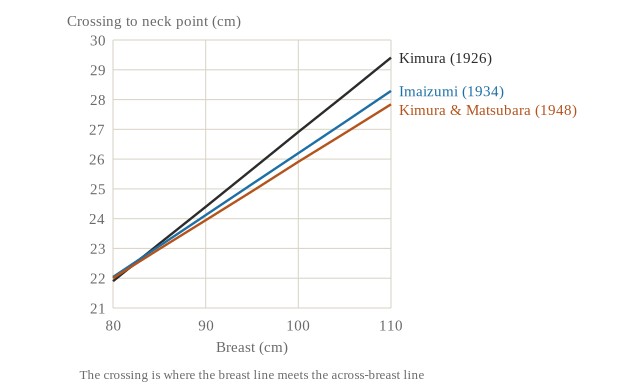
At a breast of 80cm they agree at 21.9 to 22.0cm, but they open as the breast grows, reaching 27.8 to 29.4cm at 110cm.
They open because the three settle this distance from different things. Kimura (1926) gives the distance itself as half the drafting scale B (one quarter of the full chest circumference) plus ¾ inch (1.9cm), and places the neck point on an arc struck from the crossing; it grows 0.25cm for every centimetre of breast. The other two take the neck point straight up from a point on the breast line, so it grows by the formulas seen under the scye depth, 3B/8 and B/3, which is 0.21cm and 0.19cm.
The back neck runs the other way about, Kimura (1926) being the smallest. Over the shoulder as a whole the two cancel, and the front shoulder measure below differs by no more than 1.1cm.
In the short-measure system this distance is worked out from a measurement called the front shoulder, taken from where the chest ends at the front side, over the shoulder, to right behind the neck, which is the starting point. Kimura & Matsubara (1948) make the distance from the crossing to the neck point the front shoulder measure less the back neck plus ¾ inch (1.9cm). Used the other way about, that relation gives the front shoulder measure each of the three is working to: the back neck plus this distance, less ¾ inch.
| Breast (cm) | Kimura (1926) | Imaizumi (1934) | Kimura & Matsubara (1948) |
|---|---|---|---|
| 80 | 26.9 | 28.0 | 27.6 |
| 85 | 28.6 | 29.3 | 29.0 |
| 90 | 30.2 | 30.7 | 30.4 |
| 95 | 31.9 | 32.1 | 31.8 |
| 100 | 33.6 | 33.4 | 33.2 |
| 105 | 35.2 | 34.8 | 34.6 |
| 110 | 36.9 | 36.2 | 36.0 |
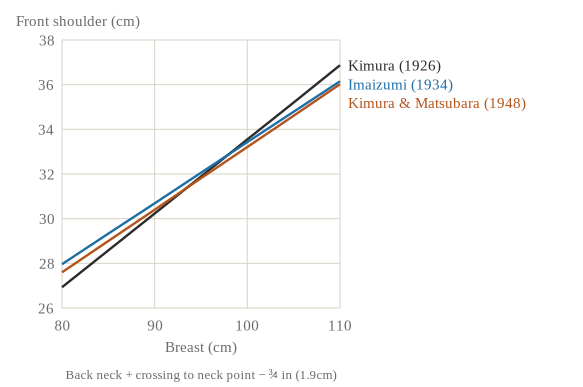
The distance from the crossing to the neck point opened as the breast grew, but the front shoulder measure stays within 1.1cm at every breast, and the opening disappears. The three stand in much the same place on the front shoulder; what differs is how they share it between the back neck and this distance. Even the 1.1cm spread at a breast of 80cm comes not from the distance but from the back neck, 6.9cm in Kimura (1926) against 7.8cm in Imaizumi (1934).
Kimura (1926) makes the distance from the crossing to the neck point half the drafting scale B (one quarter of the full chest circumference) plus ¾ inch (1.9cm), so in the relation used by Kimura & Matsubara (1948) the ¾ inch cancels. The front shoulder measure is then the back neck plus half the drafting scale B (one quarter of the full chest circumference): at a chest circumference of 90cm, B is 45cm and B/2 is 22.5cm, so add 22.5cm to the back-neck measurement.
How the shoulder seam comes forward
At the front, the measure runs from where the chest ends at the front side — the point where the breast line meets the across-breast line — to the shoulder end at the front. At the back, it runs from the shoulder end down to the breast line below it.
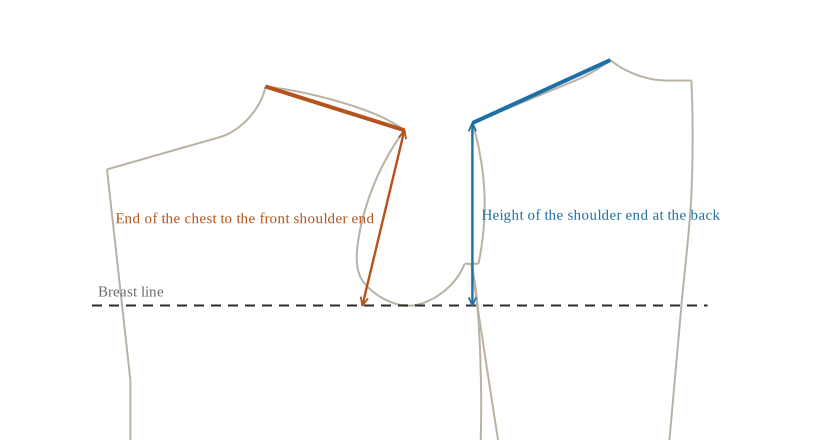
The shoulder line of the forepart is stretched when the shoulder is shaped, so the draft takes it shorter than that of the back (by ¼ inch (0.6cm) in Imaizumi (1934), by 0.6cm in Kimura & Matsubara (1948)). Measured this way, carrying the shoulder line out to the same length as the back moves the figure by only about 0.03cm, so the three can be compared without minding the difference in length.
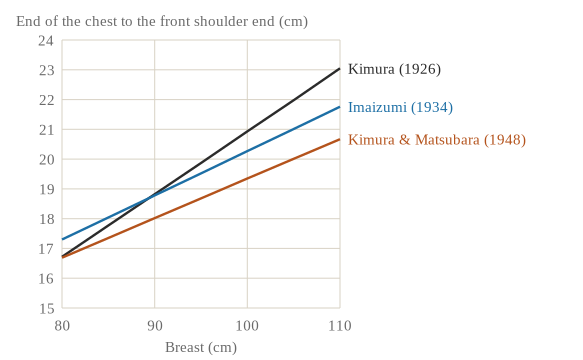
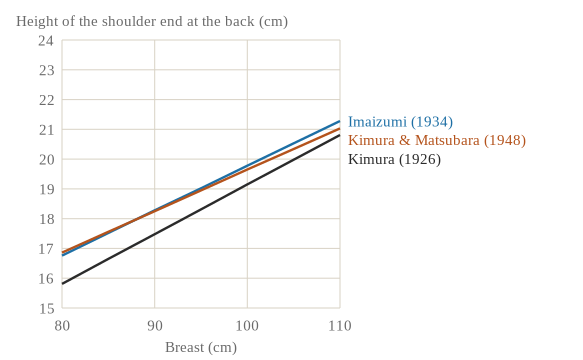
The two figures share the same scale up the side.
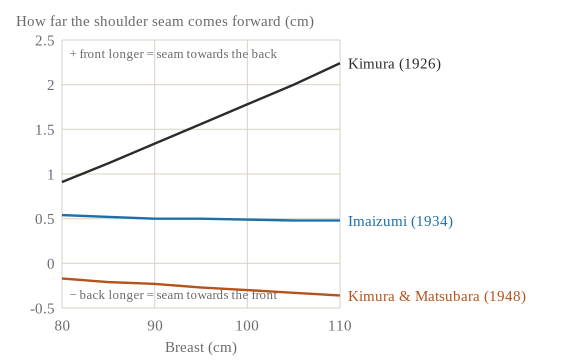
The longer the front is against the back, the further the shoulder seam goes round towards the back. At a breast of 90cm the difference is +1.3cm in Kimura (1926), +0.5cm in Imaizumi (1934) and −0.2cm in Kimura & Matsubara (1948): the older the book, the further back the seam sits.
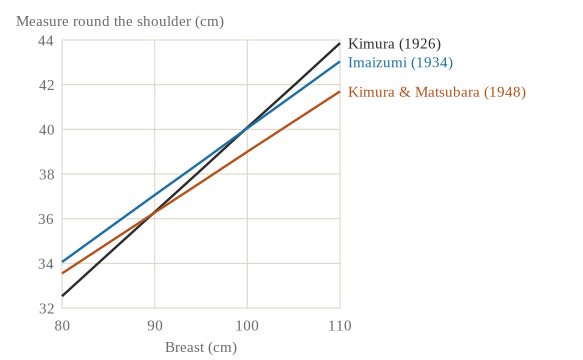
The sum shows how high the shoulder end is set, which is the choice between a square and a sloping shoulder. Here the three run much alike: at a breast of 90cm they give 36.3cm, 37.1cm and 36.3cm, within 0.8cm. As the breast grows, Kimura (1926) runs a little higher and Kimura & Matsubara (1948) a little lower, 2.2cm apart at a breast of 110cm.
The overlap
At the height of the break point, the length from the centre front line to the front edge. The break point is where the roll line reaches the front edge.
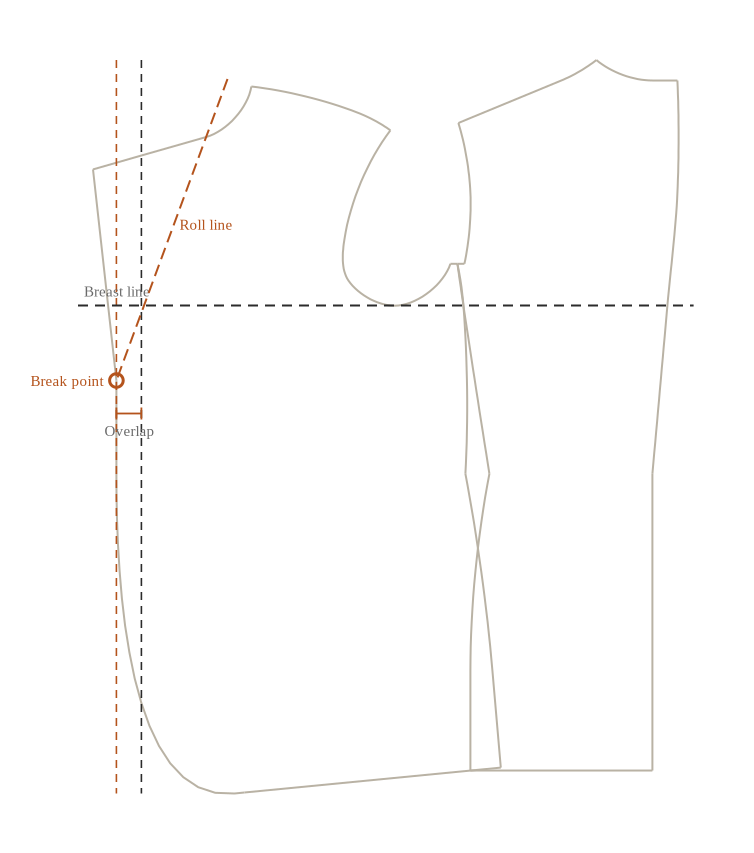
In all three it holds whatever the breast. Kimura (1926) and Imaizumi (1934) agree at 1½ inches (3.81cm); Kimura & Matsubara (1948) is shorter, at 2.5cm.
The front drop
The bottom of the forepart is not drawn level. A point is taken on the centre front line below the bottom line, and a straight line is drawn to it from the bottom at the side; the bottom out to the front edge carries that line on. How far that point drops is the front drop.
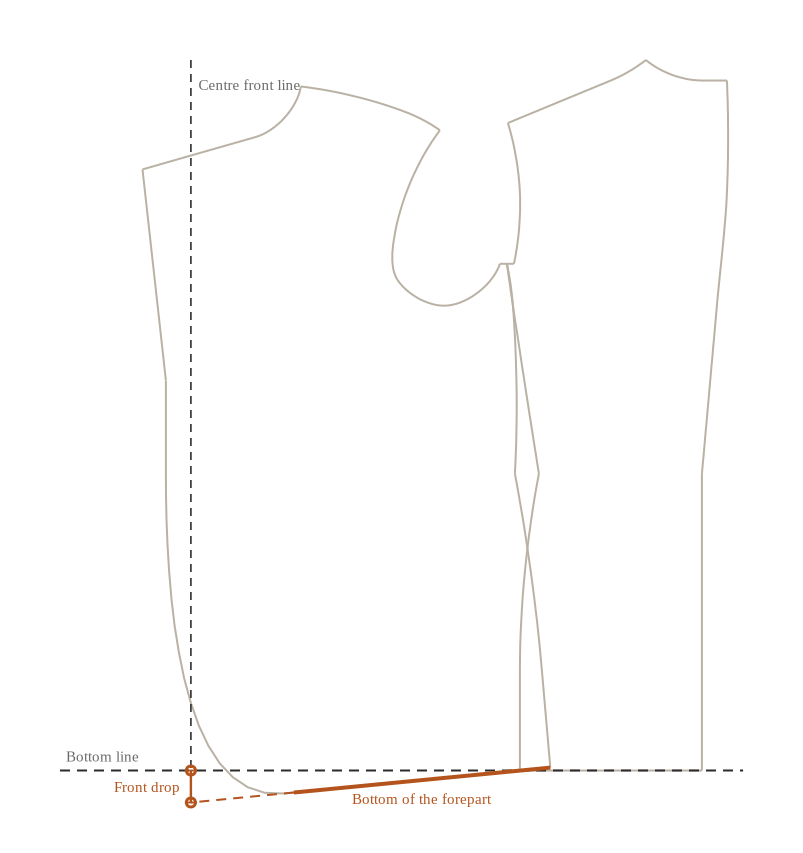
In all three it holds whatever the breast. Kimura (1926) and Imaizumi (1934) agree at 1½ inches (3.81cm); Kimura & Matsubara (1948) is a little shallower, at 3.2cm.
Since the drop does not follow the breast, the wider the body, the gentler the slope of the bottom.
The back neck
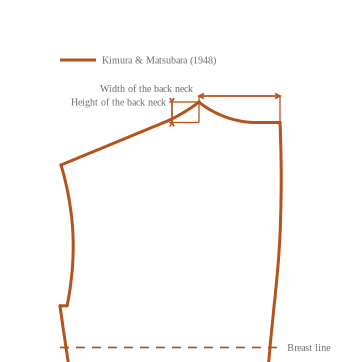
At the neck of the back, the measure from the back centre out to the shoulder line. It is looked at as a width and a height.
Width
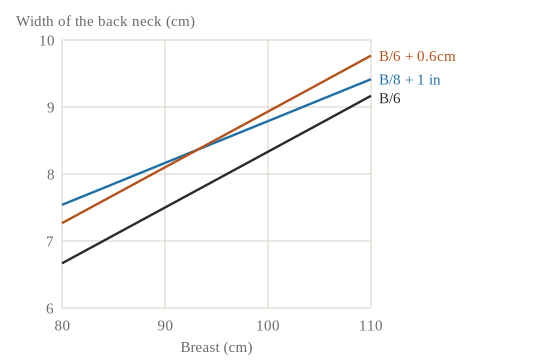
The measure across, from the back centre to where the neck line meets the shoulder line. The three fall into three forms.
Kimura (1926)               B/6
Imaizumi (1934)             B/8 + 2.54   (2.54cm = 1 inch)
Kimura & Matsubara (1948)   B/6 + 0.6
As with the scye depth, it is a fraction of B with a constant. At a breast of 90cm (B = 45cm) they give 7.5cm, 8.2cm and 8.1cm, and only the B/8 form, with the smaller fraction, comes out wider at a small breast and narrower at a large one.
Height
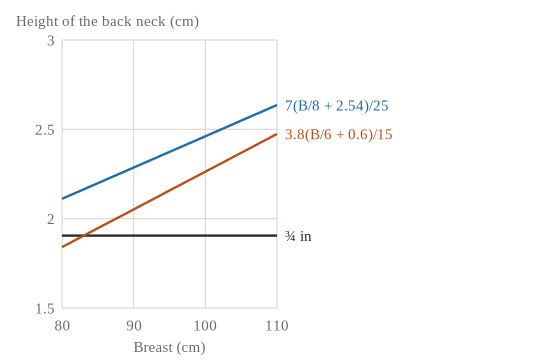
How far the meeting of the neck line and the shoulder line rises above the back centre. The three agree less closely than on the width.
Kimura (1926)               ¾ inch (1.9cm)
Imaizumi (1934)             7/25 of the width of the back neck
Kimura & Matsubara (1948)   3.8/15 of the width of the back neck
Kimura (1926) settles the height itself, so it does not follow the breast. The other two place the point on a guide line of fixed slope, so the height is the width of the back neck times that slope. The slope is 7/25 in Imaizumi (1934) (1¾ inches (4.44cm) against 6¼ inches (15.88cm)) and 3.8/15 in Kimura & Matsubara (1948) (3.8cm against 15cm), and neither follows the breast.
Only Kimura (1926) holds whatever the breast; in the other two the height grows with the width of the back neck. The further the breast grows, the further the three stand apart.
References
- Japan (1917) 『EO式洋服裁断法』 内外織物新報社 Read at the NDL Digital Collections Online
- Japan (1926) 『裁断研究』 日本毛織物新報社 Catalogue recordTransmission service
- Japan (1926) 『丸山式洋服裁断全書』 日本毛織新報社 Catalogue recordTransmission service
- Japan (1934) 『実用裁断 改訂3版』 洋服工学協会 Catalogue recordTransmission service
- Japan (1934) 『裁断基礎研究』 松崎洋服店技術部 Catalogue recordTransmission service
- Japan (1940) 『男子服裁縫の要訣』 文化服装学院すみれ会出版部 Catalogue recordTransmission service
- Japan (1948) 『図解紳士服全書』 生活研究社 Catalogue recordTransmission service
- Japan (1948) 『新撰現代洋服裁断製図集』 服装生活社 Catalogue recordTransmission service
- Japan (1948) 『テーラーズ・ハンドブック』 生活研究社 Catalogue recordTransmission service
- Japan (1961) 『図解背広講座』 文化服装学院出版局 Catalogue recordTransmission service