This page was originally written in Japanese and has been translated into English. Some photographs retain Japanese annotations; the text and captions explain the construction in English.
The Draped Sack Coat
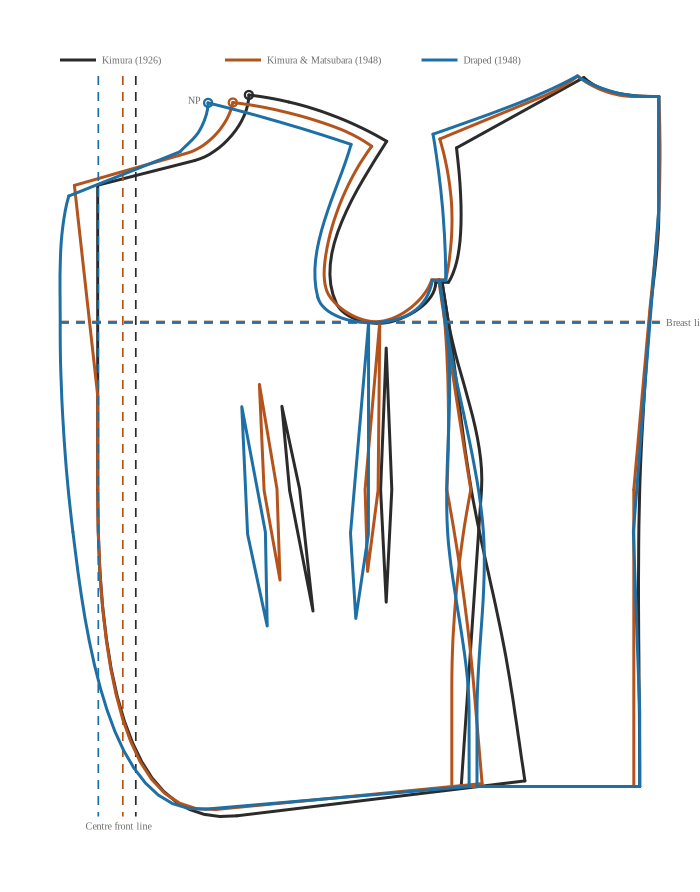
The draft of a draped sack coat, which leaves fullness over the chest, laid against the plain sack coat of the same book. How the width is divided, the ease, where the neck point sits, the shoulder and the scye.
In Japan, the plain sack coat went on being made until about 1950, and alongside it, from the war years, came the coat called the draped sack coat. What follows takes the draped sack coat of one cutting book and sets it against the plain one.
This draped coat takes more room across the chest and the back than before, and by raising the neck point it takes more room in front of the scye. The shoulder seam moves forward, which brings it closer to the modern cut.
It is set beside the plain sack coat of the same book, together with the two books used in the comparison of drafts, all drawn to the same measurements.
| Source | Draft used |
|---|---|
| 『裁断研究』(Keiichi Kimura 1926) | Single breasted, three buttons |
| 『裁断基礎研究』(Sue Imaizumi 1934) | Single breasted, two buttons |
| 『図解紳士服全書』(Keiichi Kimura, Masami Matsubara 1948) | Single breasted, three buttons |
| The draped sack coat of the same book | Single breasted, two buttons |
The measurements used are: breast 90cm, waist 80cm, seat 94cm, full length 69cm, back width 38.8cm, scye 45cm, inside sleeve length 41.5cm.
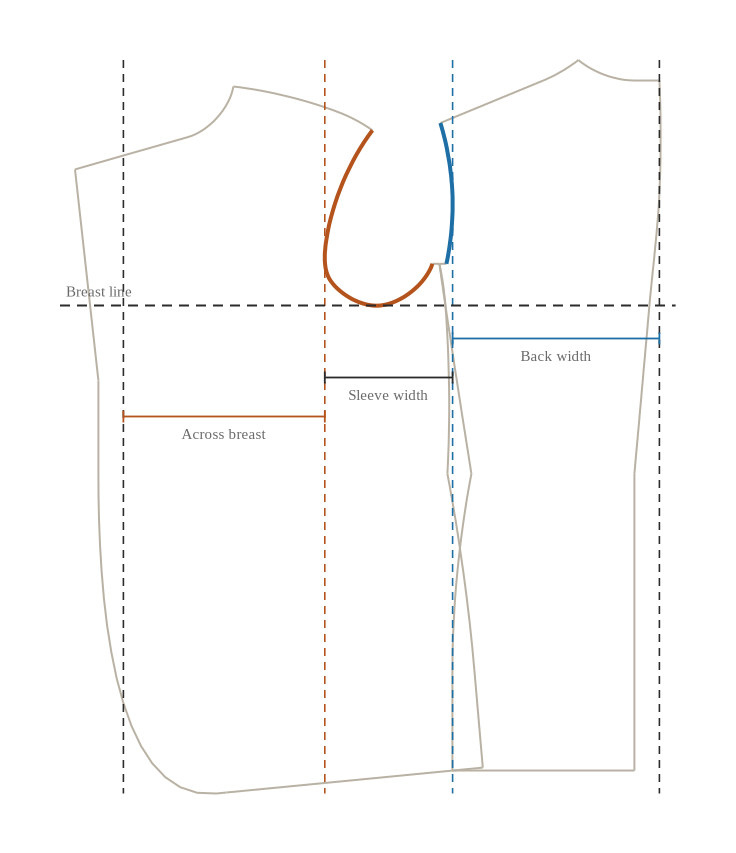
How the width is divided
The breast line is divided into the back width, the sleeve width and the across breast. The sleeve width is bounded on each side by the vertical that touches the scye. The across breast is bounded in front by the centre front line, the back width at the back by the vertical through the starting point.
The drafts were drawn again for breasts of 80, 90 and 100cm. The back width follows the breast by the formula the same book gives for reference: half the drafting power plus a third of it plus ½ inch (1.3cm).
| Breast | Back width | Sleeve width | Across breast | Half the body | Ratio | |
|---|---|---|---|---|---|---|
| 80cm | Kimura (1926) | 18.1cm | 11.2cm | 18.0cm | 47.3cm | 38 : 24 : 38 |
| Imaizumi (1934) | 17.9cm | 11.9cm | 17.5cm | 47.4cm | 38 : 25 : 37 | |
| Kimura & Matsubara (1948) | 18.6cm | 11.9cm | 18.0cm | 48.5cm | 38 : 24 : 37 | |
| Draped (1948) | 19.2cm | 12.0cm | 19.8cm | 51.0cm | 38 : 23 : 39 | |
| 90cm | Kimura (1926) | 19.8cm | 13.1cm | 19.4cm | 52.3cm | 38 : 25 : 37 |
| Imaizumi (1934) | 19.9cm | 13.2cm | 19.4cm | 52.5cm | 38 : 25 : 37 | |
| Kimura & Matsubara (1948) | 20.7cm | 12.8cm | 20.1cm | 53.6cm | 39 : 24 : 38 | |
| Draped (1948) | 21.3cm | 13.1cm | 21.7cm | 56.1cm | 38 : 23 : 39 | |
| 100cm | Kimura (1926) | 21.4cm | 15.0cm | 20.9cm | 57.3cm | 37 : 26 : 36 |
| Imaizumi (1934) | 21.9cm | 14.4cm | 21.3cm | 57.6cm | 38 : 25 : 37 | |
| Kimura & Matsubara (1948) | 22.8cm | 13.7cm | 22.2cm | 58.7cm | 39 : 23 : 38 | |
| Draped (1948) | 23.4cm | 14.2cm | 23.5cm | 61.1cm | 38 : 23 : 38 |
With the same back width put in, the draped coat is 0.6cm wider across the back and 1.3 to 1.8cm wider across the chest, about 2.4cm more over half the body. That difference hardly changes with the breast.
By ratio, the draped coat and the plain one both come to about 38 : 23 : 38, and no share differs by more than about a point. What sets the draped coat apart is not how the width is divided but the whole measure: half the body is 2.4cm larger.
The back width is in both cases half the back width measure with something added, but the plain coat adds ½ inch (1.3cm) and the draped coat ¾ inch (1.9cm). The across breast is built the same way too: on the breast line, half the breast is taken forward from the back centre, and the centre front line is set further forward again. The plain coat goes 3 inches (7.6cm) further, the draped coat 4 inches (10.2cm). The front limit of the scye is also taken differently, so the across breast ends up 1.5cm wider.
Ease
On the draft, the distance from the centre front line to the back centre line is measured, and the measurement put in is subtracted. The side seam and the side dart are cutting lines, so a seam allowance of ¼ inch is taken off each. Over half the body, the equivalent of four seam allowances is deducted: two at the side seam and two at the side dart.
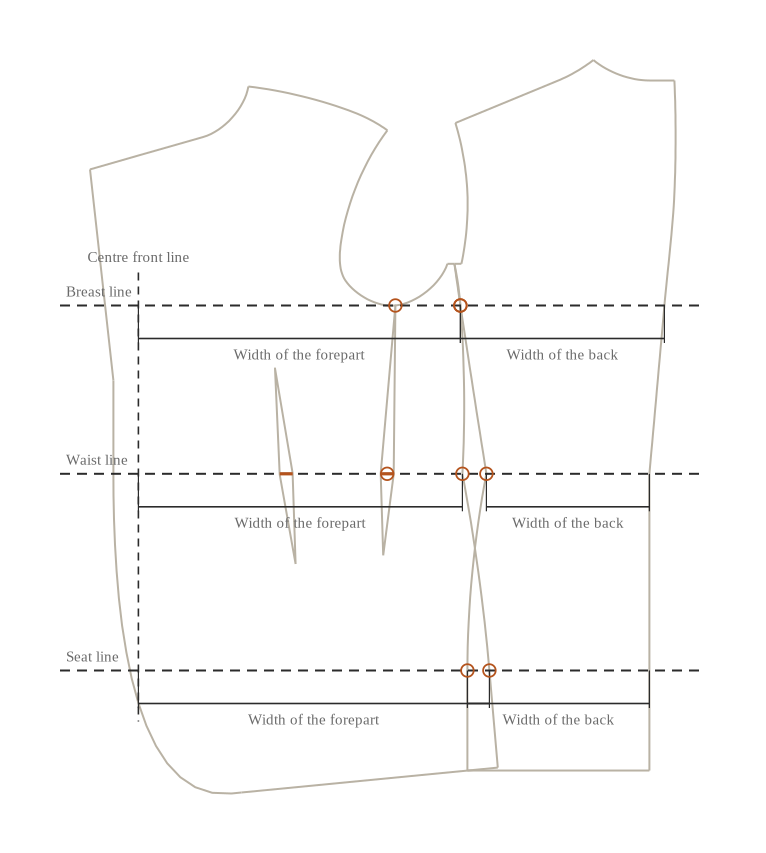
The side dart does not reach the seat line, so there only the two seam allowances of the side seam are taken off.
| Breast line | Waist line | Seat line | |
|---|---|---|---|
| Kimura (1926) | +7.1cm | +8.9cm | +11.0cm |
| Imaizumi (1934) | +7.1cm | +4.6cm | +7.4cm |
| Kimura & Matsubara (1948) | +9.6cm | +6.6cm | +9.8cm |
| Draped (1948) | +14.7cm | +7.1cm | +9.9cm |
The draped coat has more ease over the breast. Against the plain sack coat of the same book, the breast has 5.1cm more, while the waist differs by 0.5cm and the seat by 0.1cm. Fullness over the chest, nothing changed below the waist: the figures say exactly that.
Where the neck point sits
Where the neck point of the forepart falls within the across breast, taken as a proportion with the centre front line at 0% and the vertical touching the scye at 100%.
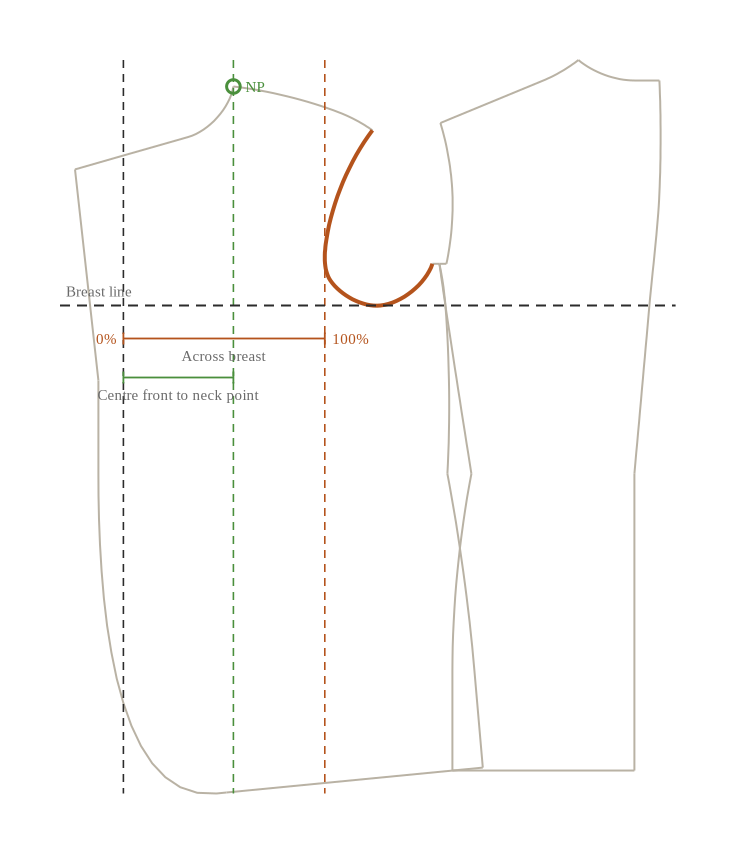
| Centre front to neck point | Neck point to scye | Position | |
|---|---|---|---|
| Kimura (1926) | 11.3cm | 8.1cm | 58.3% |
| Imaizumi (1934) | 11.0cm | 8.4cm | 56.5% |
| Kimura & Matsubara (1948) | 11.0cm | 9.1cm | 54.6% |
| Draped (1948) | 11.0cm | 10.7cm | 50.7% |
The draped coat is the furthest forward: 50.7% against 54.6% for the plain one.
From the centre front line to the neck point is about 11.0cm in all four. The difference lies on the other side, from the neck point to the scye, which runs from 8.1cm to 10.7cm.
The shoulder
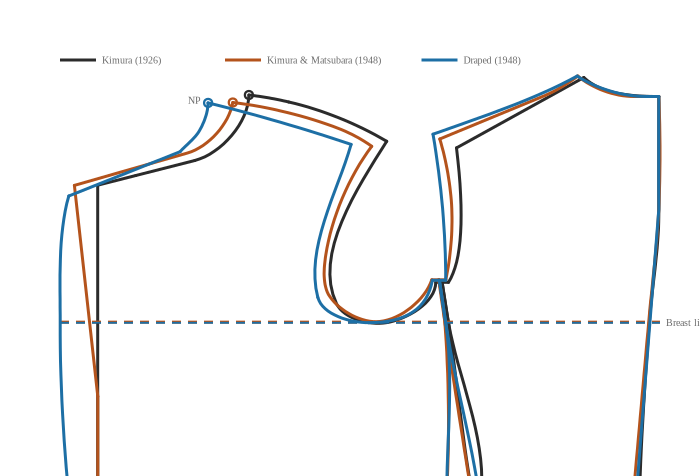
In the draped coat the line of the shoulder seam lies further towards the forepart than in the plain one. The shoulder line of the back has risen and that of the forepart has fallen by as much, so the draped coat is not a coat for square shoulders in particular.
Shaping with the iron
A different draft asks for a different way of shaping with the iron.
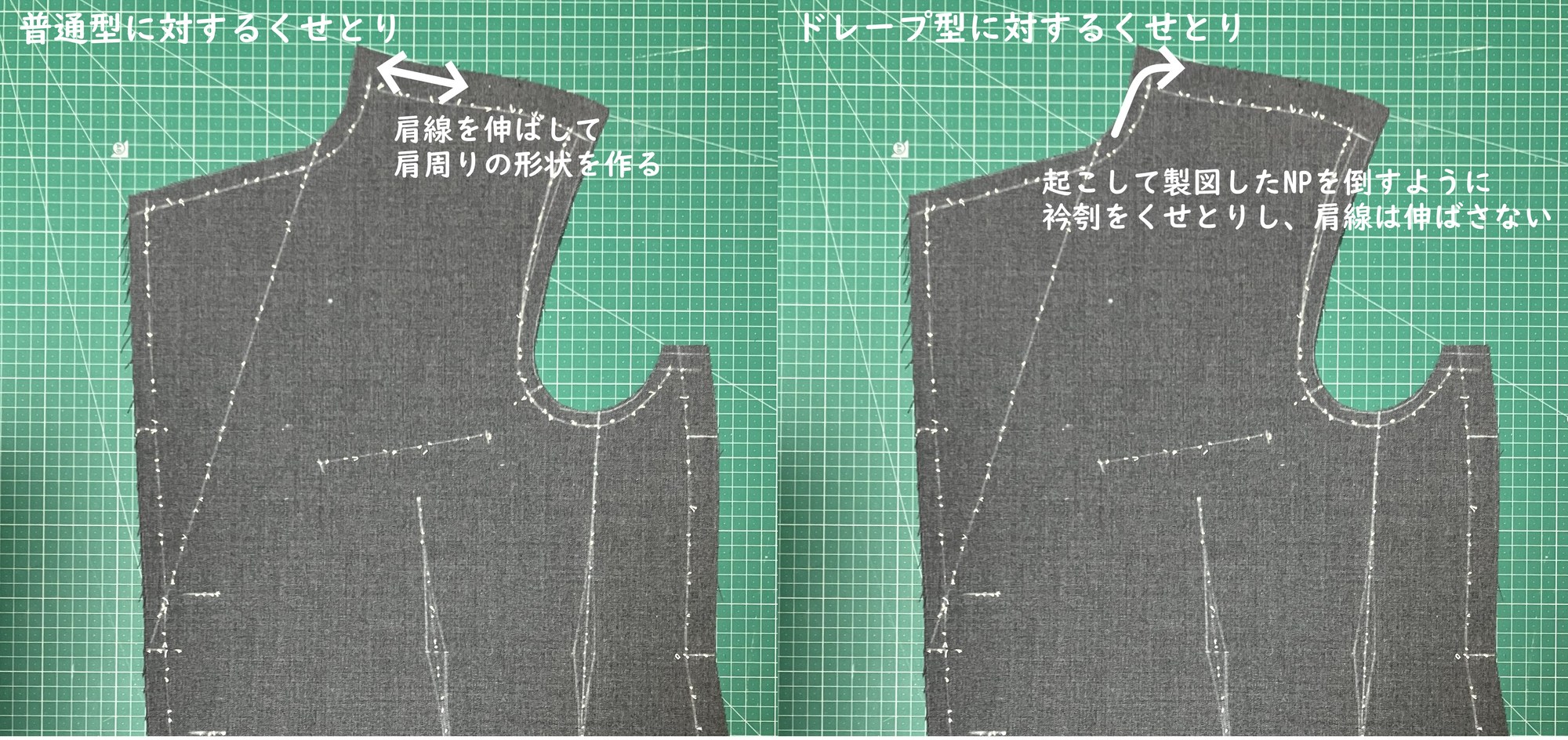
The plain coat stretches the shoulder line of the forepart near the neck point, to make room in front of the scye for the front shoulder. The draped coat does not stretch the shoulder line; it shapes the neck line instead, so as to lay down the neck point the draft has raised.
References
- Japan (1926) 『裁断研究』 日本毛織物新報社 Catalogue recordTransmission service
- Japan (1934) 『裁断基礎研究』 松崎洋服店技術部 Catalogue recordTransmission service
- Japan (1948) 『図解紳士服全書』 生活研究社 pp.62-63 Catalogue recordTransmission service