This page was originally written in Japanese and has been translated into English.
Drafting
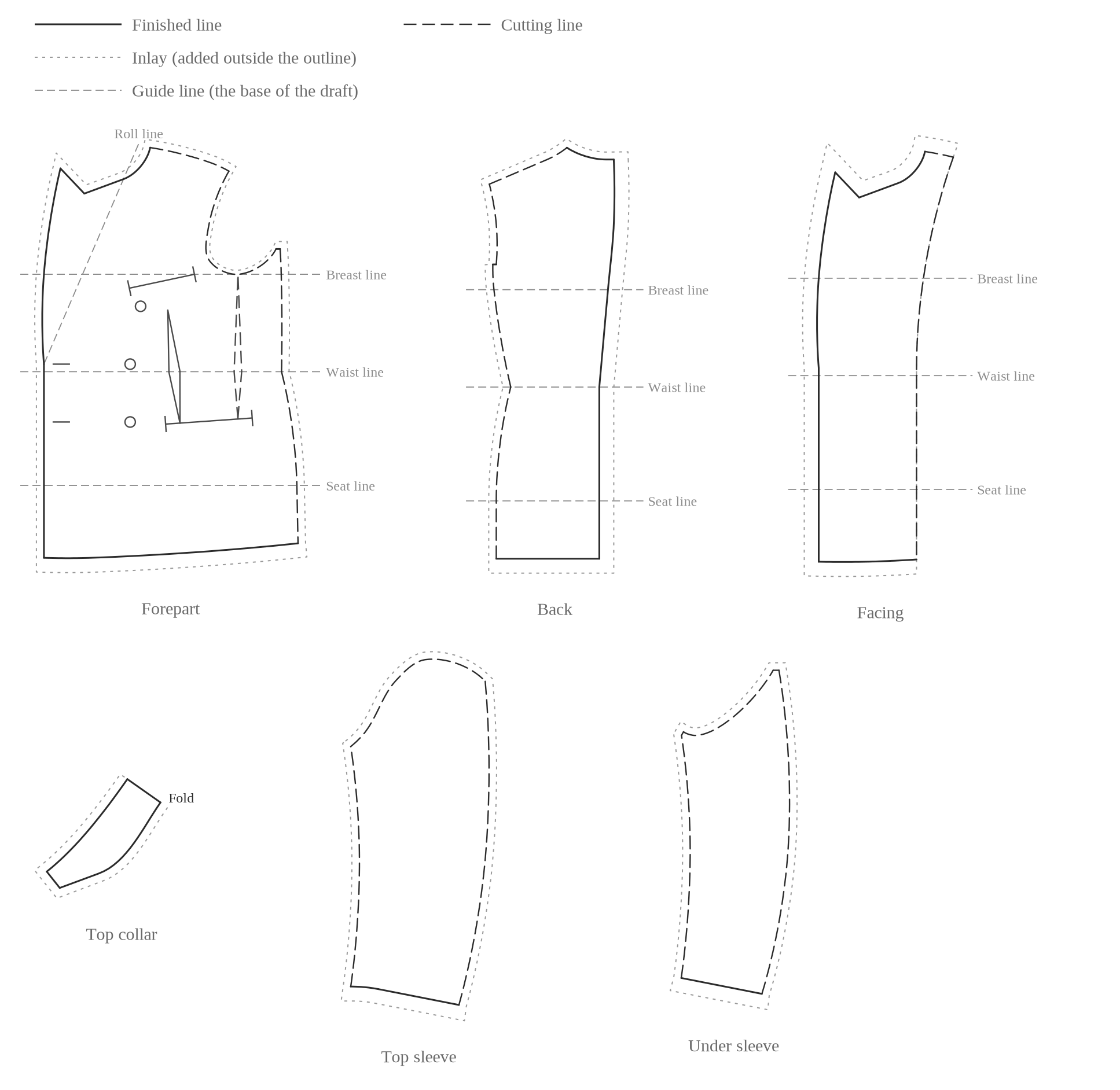
The draft of a sack coat: single and double breasted. Forepart, back, facing, top collar, top sleeve and under sleeve.
This is the draft of a sack coat (lounge jacket). Besides the forepart and the back, the facing, the top collar, the top sleeve and the under sleeve are cut.
Single breasted
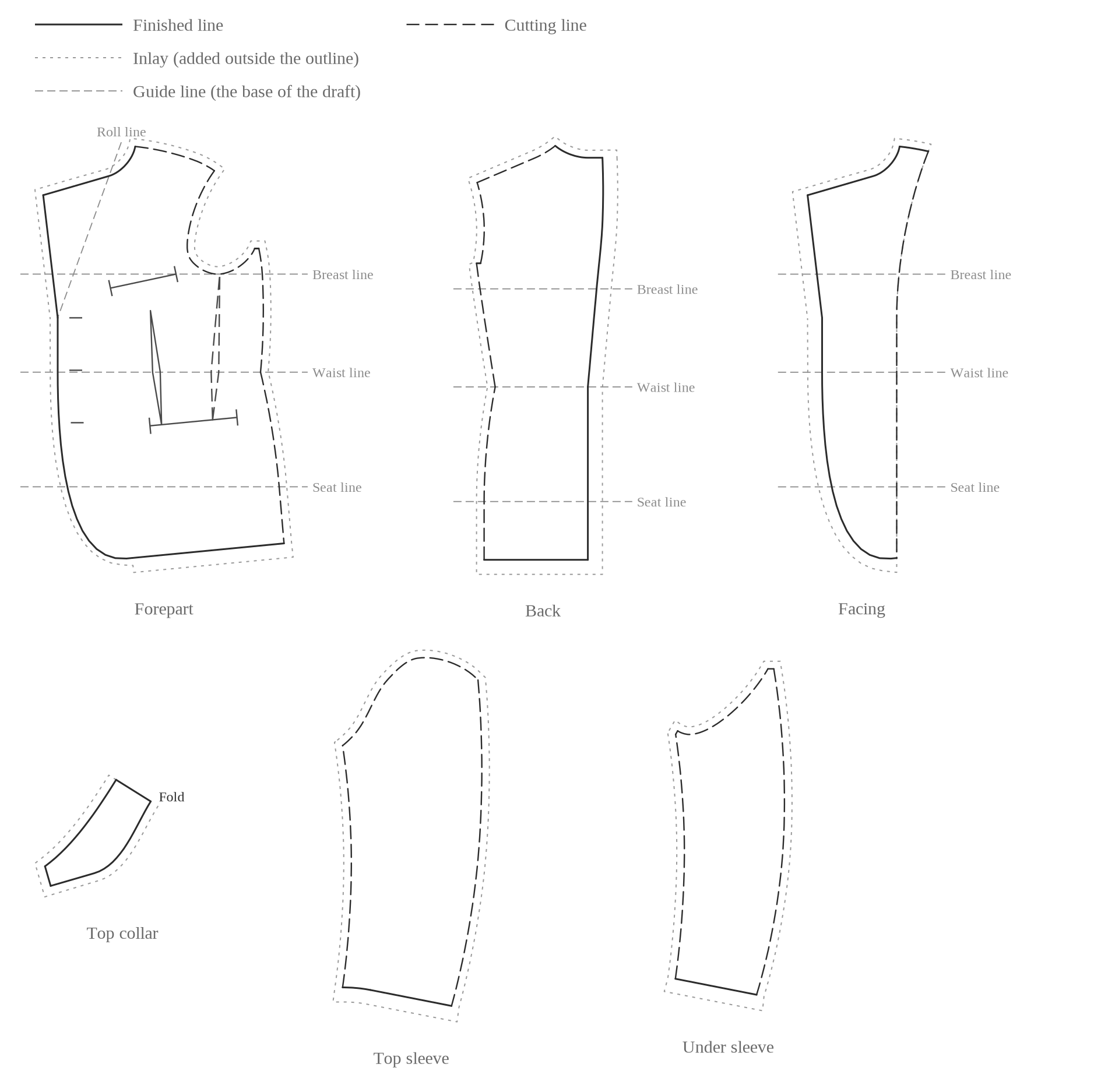
The solid and broken lines in the figure mean the following.
| Line | Meaning |
|---|---|
| Solid | The finished line, where the pieces are seamed. It does not include the seam allowance |
| Broken | The cutting line: the finished line plus the seam allowance, usually ¼ inch (about 7mm) |
The seam allowance is what the seam itself takes; the inlay is spare cloth kept for future alterations.
The inlays drawn in the figure are a guide. Some sources give figures for them, but what is drawn here does not follow any one of them. How much is left on which line is a matter of custom and taste.
Lines that fall on a fold are marked “Fold” in the figure. The cloth is folded and the two sides are cut as one.
The front usually carries two or three buttons, with exceptions. When there are two and the lower one stands out towards the edge, it is a two-button-one-to-fasten coat: the lower button is not meant to be fastened(Sue Imaizumi 1934, pp.54-55). When the lower button sits directly under the upper one, both can be fastened.
The lapel is usually notched, though it may be cut as a peaked lapel(Keiichi Kimura 1926, p.29).
Double breasted
The front edge is carried past the centre front so that the two sides lap deeply over one another. The buttons stand in two rows, one on each side of the centre front. The lapel is usually peaked; a notched lapel is uncommon.
How the body is divided
A modern sack coat divides each half of the body into three: forepart, side body and back. In older drafts the forepart and the side body are not separated, which makes two panels. There are also drafts that do not separate the forepart from the back(Tsuramitsu Cho 1934, pp.66-67).
The back centre is cut either without a vent, or with a centre vent.
Collar
Today a sack coat has a rolled collar, folded along the roll line, with the chest open. A stand collar was once counted as a sack coat as well(Keiichi Kimura 1926, p.48)(Kineo Nezu, Masami Matsubara 1949, p.32).
Pockets
A sack coat has one welt pocket at the breast on the left side, the side that laps over, and a jetted pocket on each side at the waist. The waist pockets usually have flaps.
On a sports jacket the breast and waist pockets may be patch pockets.
How each one is made is in Pockets.
Sleeve
The top sleeve is cut larger than the under sleeve, so that the sleeve turns inwards along the inside seam: the wide top sleeve. There are also drafts that cut the two the same width, the half and half sleeve(Sue Imaizumi 1934, pp.102-103).
Darts
Both drafts have a chest dart and an side dart, the dart at the side of the forepart. Some drafts of the Meiji and Taisho periods have no chest dart(Kanekichi Hatakeyama 1910, p.99)(Eitaro Ota 1917, p.6)(Keiichi Kimura 1926, p.160).
How the sources differ
Even for the same sack coat, the sources differ in how each dimension is found and how the lines are taken. Three of them, drafted to the same measurements and laid over one another, are in Comparing sack coat drafts.
Short-measure Drafting shows how strap, over-shoulder and blade measurements account for posture and build.
References
- Japan (1910) 『実用洋服裁断法』 実用洋服裁断法発行所 p.99 Read at the NDL Digital Collections Online
- Japan (1917) 『EO式洋服裁断法』 内外織物新報社 p.6 Read at the NDL Digital Collections Online
- Japan (1926) 『裁断研究』 日本毛織物新報社 pp.29・48・160 Catalogue recordTransmission service
- Japan (1934) 『実用裁断 改訂3版』 洋服工学協会 pp.66-67 Catalogue recordTransmission service
- Japan (1934) 『裁断基礎研究』 松崎洋服店技術部 pp.54-55・102-103 Catalogue recordTransmission service
- Japan (1949) 『裁断の基礎研究』 洋装社 p.32 Catalogue recordTransmission service